Trupeer Blog
How to Use MCP Servers to Make Your Video Content Queryable by AI Agents
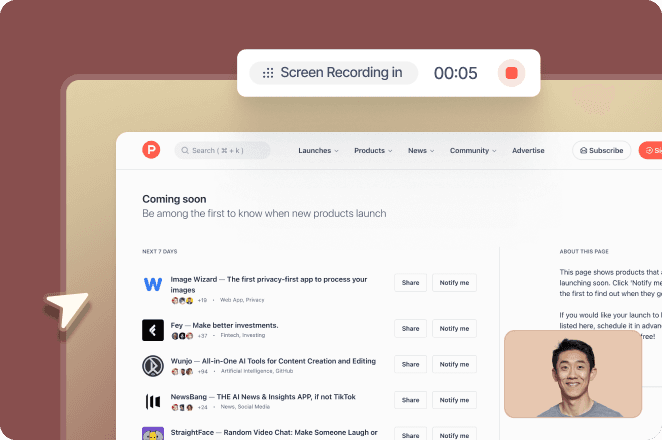
Imagine you've built an extensive video library for your enterprise, loaded with product demos, training sessions, and customer testimonials. Each video is a treasure trove of valuable information. But accessing specific segments on demand is a challenge. That's where MCP (Media Content Protocol) servers come into play. By integrating MCP servers, you can transform your video content into a queryable database. This means AI agents can sift through your videos, pulling out the exact clips or information you need instantly. According to recent data, companies that have integrated AI video search capabilities have seen a
40% increase in employee productivity
by reducing the time spent on content retrieval. For organizations looking to use their video assets more efficiently, this integration is a big shift. Whether you're in HR, marketing, or product development, making your video library easily accessible can simplify operations and build innovation. For a deeper look, our guide on make product demo video covers the adjacent playbook.
Why does making your video content queryable by AI agents matter?
In a business landscape where information is power, the ability to quickly access and use video content can give an organization a competitive edge. Videos often contain the most up-to-date and detailed data, but without the right tools, extracting specific information can be tedious. Imagine a scenario where a sales team needs to locate a particular product demonstration snippet to address a client's question during a live call. Without a queryable video library, they might waste precious minutes, or even hours, manually scrubbing through footage. This inefficiency not only affects response time but can also impact the customer experience and potential sales outcomes.
Also, the need to make video content queryable is amplified by the rise of remote work and global teams. Employees across different time zones and locations need smooth access to the same resources. By integrating MCP servers with AI capabilities, businesses can ensure that their teams have instant access to the information they need, regardless of where they are. This is particularly crucial for sectors like education and training, where timely access to specific video content can enhance learning and retention. For companies aiming to enhance their ai adoption workflow, making video content queryable by AI agents is no longer optional, it's a necessity.
What are the benefits of making your video content queryable by AI agents?
Transforming your video library into a searchable database with AI agents offers several compelling benefits:
Increased Efficiency. AI agents can quickly locate specific video clips, reducing the time employees spend searching for information. This efficiency boost translates into higher productivity and faster decision-making.
Improved Knowledge Sharing. By making video content easily searchable, teams can share knowledge more effectively, leading to better collaboration and innovation across departments. For instance, a single ai video editing tool can simplify content creation and sharing.
Enhanced Customer Service. Customer support teams can rapidly access relevant video content to resolve issues, improving response times and customer satisfaction. A centralized AI video platform can significantly enhance service delivery.
Cost Savings. Automating video search reduces the need for manual intervention, cutting down on labor costs. Businesses can reallocate resources to more strategic initiatives, optimizing their operational budgets.
Scalability. As your video library grows, AI agents ensure that content remains easily accessible, preventing the common bottleneck of scaling information retrieval processes. This scalability is crucial as companies expand their digital assets.
Data-Driven Insights. AI agents can analyze video content to extract insights on viewer behavior and engagement, helping businesses refine their content strategies and improve ROI.
Which Trupeer features help you make your video content queryable by AI agents?
Trupeer offers a suite of features that facilitate the integration of MCP servers, making your video content accessible to AI agents. Here are some key capabilities:
AI-searchable knowledge base
Trupeer's AI-searchable knowledge base is a cornerstone feature for making video content queryable. This tool indexes every recording with timestamp-level deep links, enabling AI agents to pinpoint exact moments within videos. This feature is particularly beneficial for organizations with extensive video libraries, as it allows for granular search capabilities. By implementing this, companies can ensure that their teams access relevant content with just a few keywords, minimizing downtime and boosting productivity.
Automatic SOP generation
With Trupeer's ability to generate auto-generated documentation from video recordings, businesses can create structured content that is easily navigable by AI agents. This feature allows you to convert video content into text-based SOPs (Standard Operating Procedures), which can be queried and accessed swiftly. This not only aids in the rapid dissemination of information but also ensures that procedures are consistently followed, enhancing operational efficiency and compliance.
AI avatars / talking-head video
The create your own custom ai avatar video feature allows businesses to produce talking-head videos that can be smoothly integrated into their video libraries. These videos, when indexed, become easily searchable by AI agents, allowing for dynamic and interactive query results. This capability is ideal for training and onboarding purposes, where personalized video content can significantly enhance learning outcomes and engagement.
Auto chapters and segment detection
Trupeer's auto chapters and segment detection make it easy to break down complex videos into manageable segments. This feature is critical for AI agents that need to query specific sections of a video quickly. By automatically segmenting content, you ensure that AI agents can retrieve and present the most relevant clips to users, enhancing the overall user experience and ensuring that information is readily available when needed.
Viewer engagement analytics
Understanding how viewers interact with video content is crucial for optimizing it for AI queries. Trupeer provides detailed viewer engagement analytics, including drop-off rates and heatmaps. This data allows businesses to refine their content strategy, ensuring that videos are not only engaging but also structured in a way that makes them easy for AI agents to query. By using these insights, companies can enhance the effectiveness of their video libraries, making them a more valuable asset.
How do you use MCP servers to make your video content queryable by AI agents step by step with Trupeer?
Step 1: Record and Capture Video
Begin by capturing your video content using Trupeer's AI screen recording capabilities. This can be done via the browser-based recorder, which requires no installation, or through the desktop app for more solid features. As you record, Trupeer automatically detects clicks and zooms in on relevant areas to highlight interactions. This ensures that your video content is detailed and ready for AI querying. The recording process is smooth, typically taking no longer than the length of the video itself to complete. In cases of extended recordings, consider breaking the content into sections for easier management and later querying.
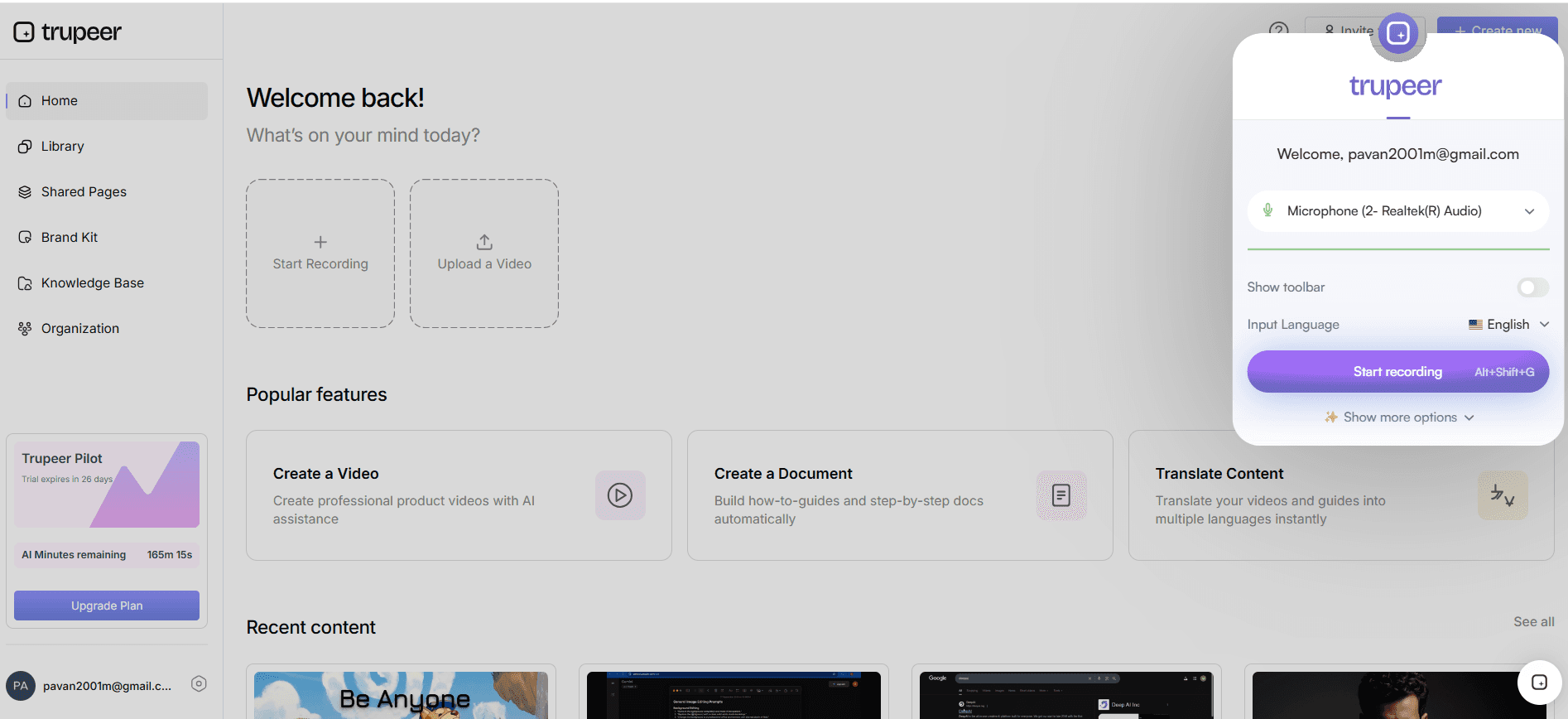
Step 2: Enhance and Edit Video
Once your video is recorded, use Trupeer's AI editing tools to enhance it. You can remove filler words and long pauses automatically, which makes the content cleaner and more concise. This step is crucial as it directly affects how searchable and effective your video content will be. With AI voiceover capabilities offering 65+ natural voices, you can also adjust the pace and tone to better suit your audience. Editing usually takes just a few minutes per video, depending on its length. Edge cases might include videos with heavy background noise, which may require additional manual adjustments.
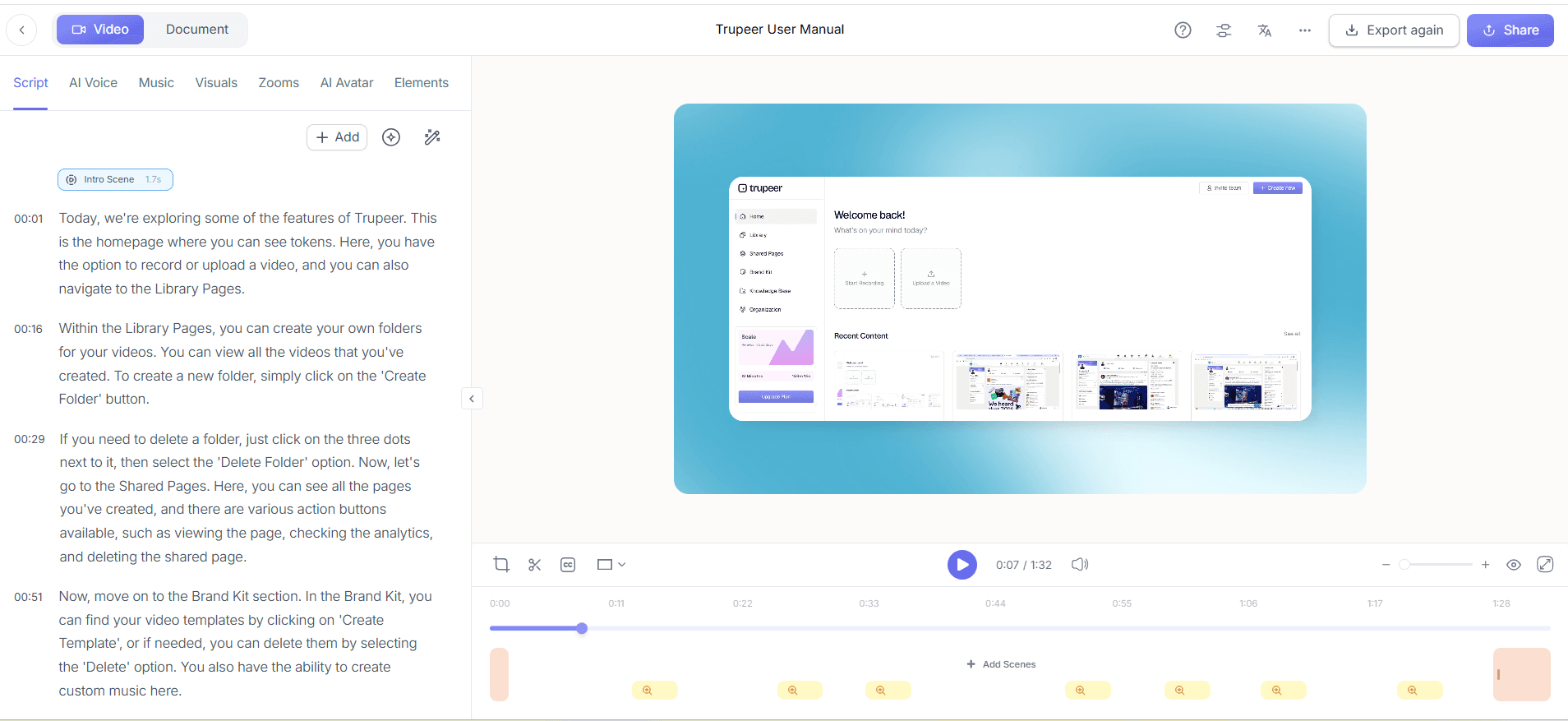
Step 3: Generate SOPs from Video
Next, use Trupeer's automatic SOP generation feature to create structured documentation from your videos. This involves selecting the desired video and clicking the 'Generate SOP' button. Trupeer then transcribes the video content and organizes it into an editable document. This document can be exported in multiple formats, including PDF and HTML, making it versatile for various uses. The generation process is quick, typically taking a few minutes, and ensures your content is both accessible and actionable for AI agents. Remember, for videos with complex information, review the SOPs for accuracy before distribution.
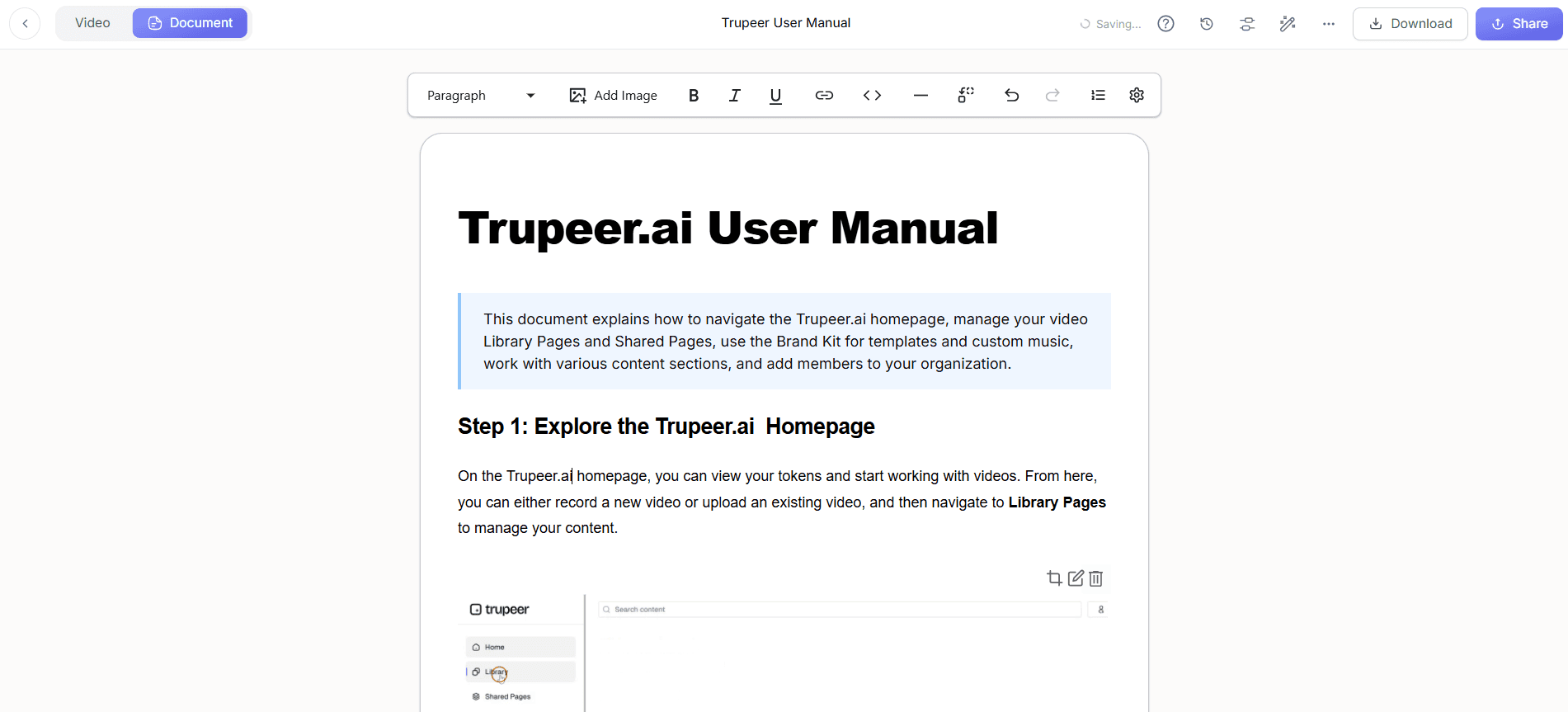
Step 4: Translate and Localize Content
With the video and SOPs ready, use Trupeer's AI translation and dubbing features to localize your content. This is essential for global teams and audiences. Trupeer supports translation into over 40 languages with precise lip-syncing. To do this, select the translation option, choose your target languages, and let the system process the content. Localization is generally fast, with each language translation taking about 10 minutes per video, varying with video length. Be mindful of languages with unique dialects, as they may require additional cultural context adjustments.
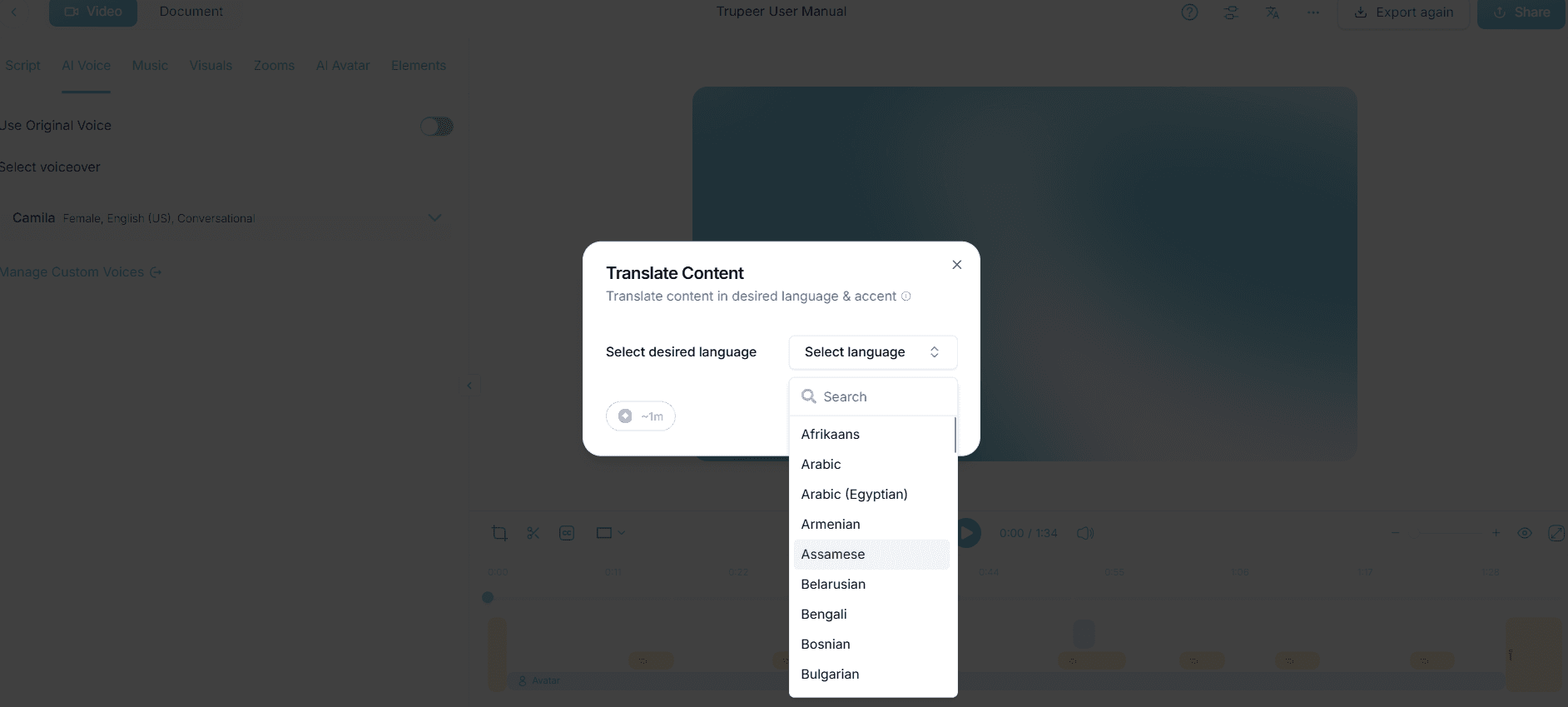
Step 5: Host and Distribute Videos
After localization, host your videos on Trupeer's platform with custom-domain hosting and SSO for secure access. This step involves uploading your final video and selecting the hosting preferences. By creating a custom-domain environment, you maintain brand consistency and control over who accesses the content. Hosting is instantaneous once the video is uploaded. Use the embeddable video widgets for embedding content directly into apps or websites, providing direct access to your audience. Ensure that the hosted content is updated regularly to maintain relevance and accuracy.
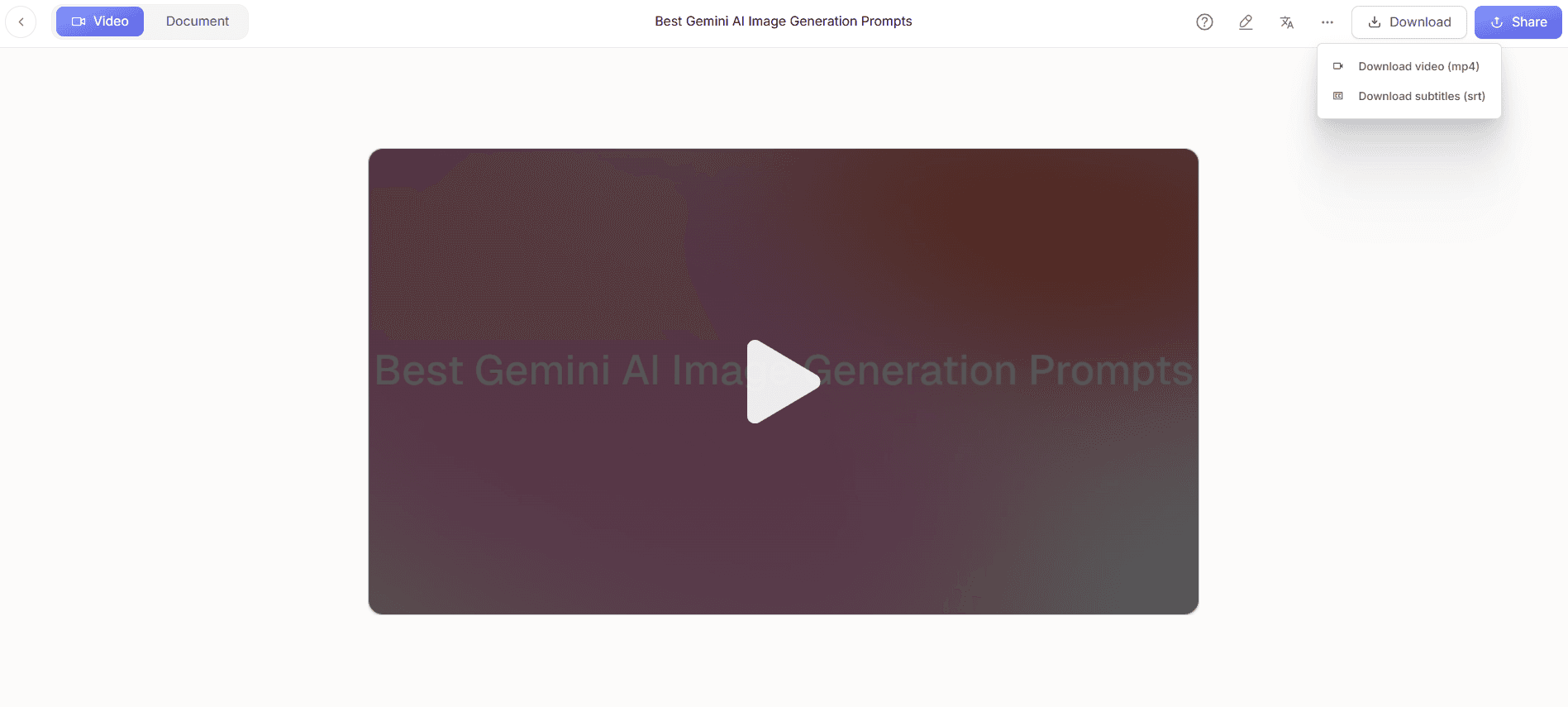
Step 6: Enable AI Querying with MCP Integration
Finally, integrate MCP servers to make your video content fully queryable by AI agents like Claude. This involves handling to the integration settings in Trupeer and activating the MCP option. Once enabled, your video library's metadata and segments are indexed, allowing AI agents to query specific parts efficiently. This integration typically takes a few minutes to set up initially but offers ongoing benefits as your content library grows. Consider a periodic review of the AI querying performance to fine-tune settings for better search accuracy.
What tips help you make your video content queryable by AI agents?
Implementing MCP servers effectively requires strategic planning and execution. Here are some actionable tips to ensure your video content is well queryable by AI agents:
Standardize Video Formats. Use consistent formats across your video library to ease AI indexing. This not only saves time but also ensures uniformity in quality and access.
Regularly Update Content. Keep your content relevant by updating videos periodically. This helps maintain engagement and ensures AI agents deliver the most current information.
use Metadata Efficiently. Enhance AI search capabilities by tagging videos with detailed metadata. This makes it easier for AI agents to locate specific content quickly.
Optimize for Multiple Languages. use Trupeer's localization tools to make your content accessible globally. This expands your reach and enhances AI interaction with diverse audiences.
Maintain a Secure Environment. Ensure your video content is hosted securely with SSO and encrypted domains. This protects sensitive data and maintains user trust.
Monitor AI Performance. Regularly assess how well AI agents are querying your content. Use analytics to tweak settings for improved accuracy and efficiency.
Compare Tools for Best Fit. When choosing a platform, consult resources like Scribe vs Trupeer comparison to find the best tool for your specific needs.
Frequently asked questions
How can I make my video content accessible to international teams?
To make video content accessible to international teams, use Trupeer's AI translation and dubbing features. These tools allow you to translate video content into over 65 languages, providing accurate lip-syncing for non-English audiences. This ensures that your international teams receive content in their preferred language, enhancing understanding and engagement. also, by hosting videos on platforms that support multi-language interfaces, you further improve accessibility and inclusivity across global teams, building a more cohesive work environment.
What is the importance of metadata in AI video querying?
Metadata plays a crucial role in AI video querying as it provides essential context and details about the video content. By tagging videos with specific metadata like keywords, descriptions, and timestamps, you enable AI agents to perform more accurate and efficient searches. This not only improves the speed at which information is retrieved but also enhances the relevance of search results. Proper metadata tagging is essential for maximizing the utility of your video library, making it a vital component of effective AI integration.
Can AI agents handle large video libraries effectively?
Yes, AI agents are designed to handle large video libraries effectively, especially when integrated with MCP servers. These servers allow for the efficient indexing and querying of extensive video collections. AI agents use advanced algorithms to quickly locate and retrieve specific video segments, regardless of the library's size. However, it's important to regularly monitor and optimize the system to ensure it remains efficient as the library grows. This includes updating metadata and assessing AI performance metrics to maintain best functionality
Does Trupeer support video localization for different languages?
Yes, Trupeer supports video localization for different languages through its AI translation and dubbing features. By accessing the video localization tool, users can translate and dub video content into over 65 languages with precise lip-syncing. This capability allows organizations to reach a broader audience and cater to diverse linguistic needs, ensuring that their content is inclusive and accessible globally. Localization not only broadens your market reach but also enhances user engagement and satisfaction.
Related Blogs