Trupeer Blog
Summarise
Imagine you’re tasked with creating a series of training videos for a new product launch. These videos need to be engaging, consistent, and resonate with a diverse audience. But hiring professional voice talent for narration is costly and time-consuming. This is where AI voice cloning steps in, offering a cost-effective solution to generate custom AI voices from a small sample. You can create authentic-sounding narrations without the overhead of traditional methods. A recent study found that
using AI voice cloning can reduce production costs by up to 50% compared to traditional voiceover methods.
This technology is not just about cost savings; it also allows for rapid iteration and localization, key factors market. For businesses, especially those operating across multiple regions, the ability to quickly produce consistent, high-quality audio content can significantly enhance training effectiveness and engagement.
Whether you're a content creator, a training manager, or a product marketer, AI voice cloning can transform the way you approach training videos. It enables you to maintain a consistent brand voice across different languages and geographies, ensuring that your message is clear and impactful. As more companies adopt AI-driven solutions, understanding how to use these tools effectively is crucial for staying competitive and meeting the needs of a diverse audience.
Why does AI voice cloning matter for training and demo videos?
AI voice cloning is a big shift for businesses needing to produce high-quality training and demo videos without the hefty price tag of professional voice actors. The demand for content that’s both engaging and informative is at an all-time high. Companies often face the challenge of balancing budget constraints with the need for effective training materials. AI voice cloning offers a solution that meets these needs by providing a scalable, cost-effective alternative to traditional voiceovers.
For stakeholders like content creators, training managers, and marketing teams, AI voice cloning can significantly simplify the production process. It allows for rapid creation and iteration, which is particularly beneficial in industries where products and services frequently evolve. By reducing the time and cost associated with voiceover production, businesses can focus on refining their content and ensuring it meets their audience's needs. This is particularly relevant for companies looking to improve their AI adoption workflow, as it enables more frequent updates to training materials, keeping them relevant and up-to-date.
Also, AI voice cloning supports the creation of personalized and localized content. This capability is crucial for companies with a global presence that need to address diverse audiences in their native languages. Consistency in messaging across different languages and regions can enhance brand perception and customer engagement. As companies continue to expand their reach, the ability to produce tailored content efficiently becomes an invaluable asset in maintaining a competitive edge.
What are the benefits of AI voice cloning for training and demo videos?
AI voice cloning offers multiple advantages that can raise your training and demo video production. Here are some of the key benefits that you can expect when implementing this technology:
Cost Reduction. AI voice cloning substantially cuts down on the expenses associated with hiring voice talent. This can reduce production costs by up to 50%, allowing you to allocate resources to other critical areas.
Speed and Efficiency. AI-generated voices can be created quickly, enabling faster turnaround times for video production. This means you can respond to market changes and update your content swiftly.
Consistency Across Content. With AI voice cloning, you can maintain a consistent voice across all your videos, strengthening your brand identity. This is particularly useful for repurpose demo videos and ensuring uniformity.
Localization and Personalization. The technology supports multiple languages, allowing you to tailor your content for different regions and demographics. This enhances audience connection and engagement.
Scalability. As your content needs grow, AI voice cloning scales effortlessly, supporting the rapid production of large volumes of content without sacrificing quality.
Flexibility. The ability to adjust tone and pace means you can customize the delivery to suit different types of content, from technical training to promotional materials, using an AI-powered video tool.
Which Trupeer features help you create AI voice cloning for videos?
Trupeer offers a suite of features designed to enhance your video production workflow with AI voice cloning. These features simplify the process, ensuring high-quality outcomes while saving time and resources.
AI screen recording with auto-zoom and click detection
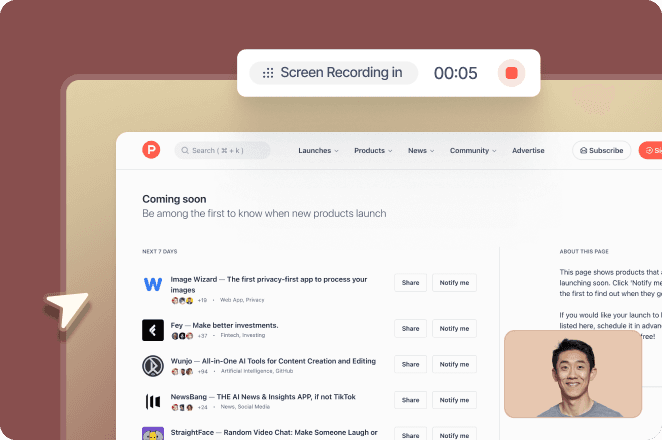
Trupeer's screen recording capabilities allow you to capture your workflows with precision. The auto-zoom feature ensures that viewers focus on the critical parts of your screen, while click detection highlights interactions. This functionality is perfect for creating tutorial videos where you need to demonstrate processes clearly. By integrating this with AI voice cloning, you can produce detailed and engaging training videos that convey complex information effectively.
AI voice cloning from a short sample
With Trupeer, you can create a custom AI voice using just a short audio sample. This feature is ideal for maintaining a consistent voice across your video content. By using this capability, you can ensure that your audience receives a uniform auditory experience, enhancing brand recognition. Whether you need a formal tone for corporate training or a conversational style for product demos, Trupeer’s voice cloning adapts to your needs. This is exactly where voice cloning training video becomes useful — and it's the kind of content Trupeer can generate directly from a simple screen recording.
AI avatars / talking-head video
Trupeer's AI avatars add a visual element to your voice-cloned content. The platform offers a library of stock avatars, plus the option to create custom ones. This is particularly useful for engaging audiences who respond well to visual storytelling. By combining AI avatars with voice cloning, you can produce dynamic videos that capture attention and convey your message more effectively. This feature aligns well with AI documentation platform needs, where visual and auditory elements must work in harmony.
Automatic filler-word removal
Trupeer automatically removes filler words like "um" and "ah," as well as long pauses from your recordings. This ensures that your videos are polished and professional, enhancing viewer engagement. Clean audio is vital for maintaining audience attention, and this feature helps achieve that by delivering concise and focused content. It’s particularly advantageous when creating instructional videos where clarity is paramount.
AI translation into 65+ languages with lip-sync
Trupeer supports the translation of your voice-cloned content into over 40 languages, complete with lip-sync. This feature is essential for companies operating globally, as it allows you to produce localized content that resonates with diverse audiences. By ensuring that translations are synchronized with on-screen visuals, you maintain the integrity of your message. It’s a powerful tool for expanding your reach and engaging a broader audience, facilitated by the AI-searchable knowledge base.
How do you create AI voice cloning for videos step by step with Trupeer?
Step 1: Record Your Screen
Start by using Trupeer's browser-based recorder. Navigate to the section of your screen you want to capture and begin the recording session. Trupeer's AI screen recording with auto-zoom and click detection will automatically focus on key areas and interactions. This ensures that your video is engaging and highlights essential details. You can record in silence while the system prepares for later voice integration. The recording process is intuitive; simply click “Start Recording,” and once done, click “Stop” to save your capture. This step typically takes as long as your session, but the setup is swift, usually under a minute. Trupeer also ships a beginner friendly video editor for training videos that handles this step without extra setup.
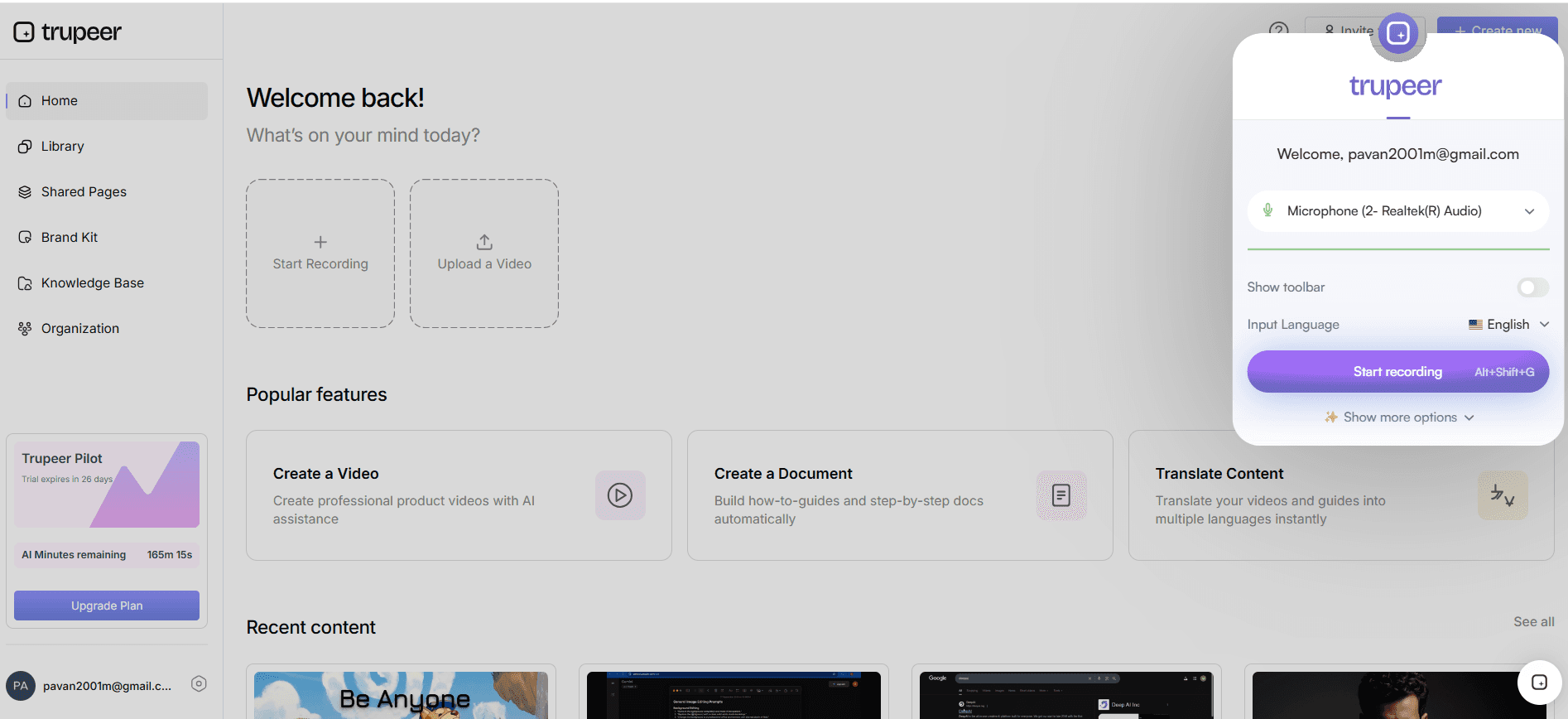
Step 2: Generate AI Voice Cloning
With your screen recording ready, proceed to Trupeer's AI voice cloning from a short sample feature. Upload a brief audio clip of the desired voice to be cloned. Trupeer processes this sample to create a custom AI voice matching the intonation and tone of the original speaker. It’s as simple as uploading the file and clicking “Generate Voice.” This process takes only a few minutes, depending on the complexity of the voice. Ensure the sample is clear and concise to avoid any distortion in the cloned voice, which is crucial for maintaining quality.
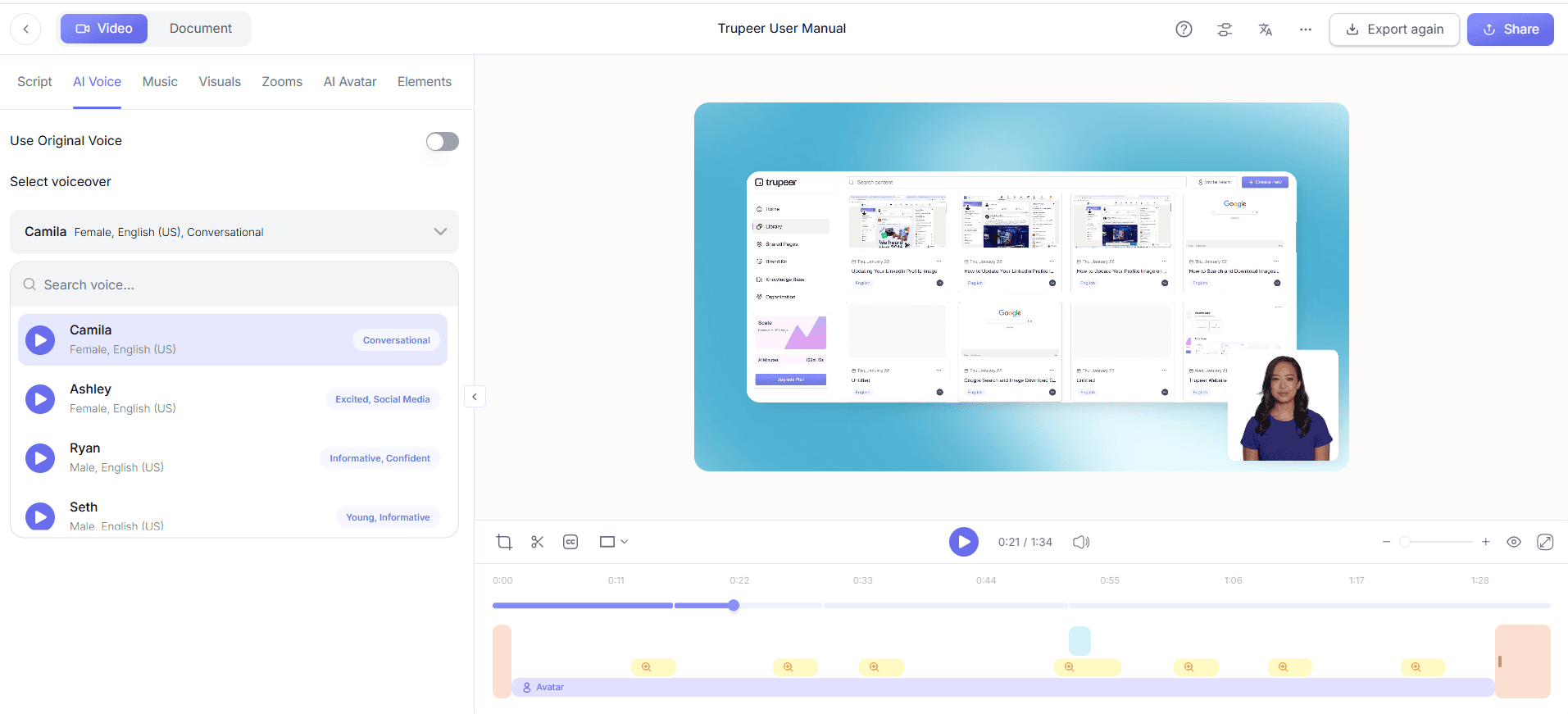
Step 3: Sync Voice with Video
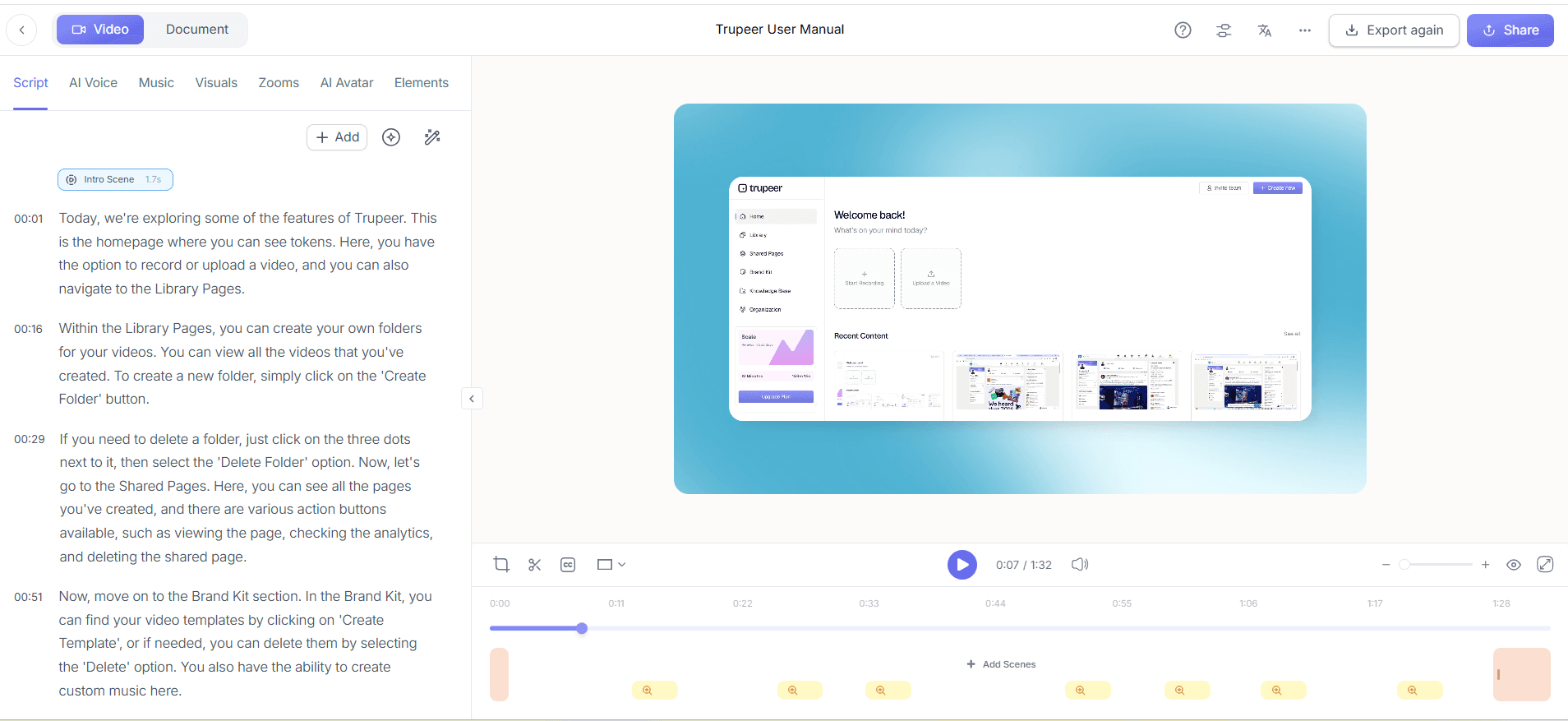
After generating the AI voice, sync it with your screen recording. Trupeer provides an intuitive interface for aligning audio with video content. Use the timeline editor to drag and drop your AI-generated voiceover onto the recorded video track. The system allows for precise adjustments, ensuring that speech matches on-screen actions smoothly. This step might require some trial and error to get the lip-sync perfect, but typically, it should take around 10 to 15 minutes to fine-tune.
Step 4: Enhance with AI Avatars
Add a visual layer to your video by integrating Trupeer's AI avatars. Choose from the stock library or create a custom avatar to enhance engagement. This feature is particularly useful for making your training videos more interactive. Simply select the “Add Avatar” option and pick your desired character. The avatar will be synchronized with your AI voice, providing a cohesive visual and auditory experience. This step is quick, often completed in under five minutes, assuming no custom avatar creation is needed.
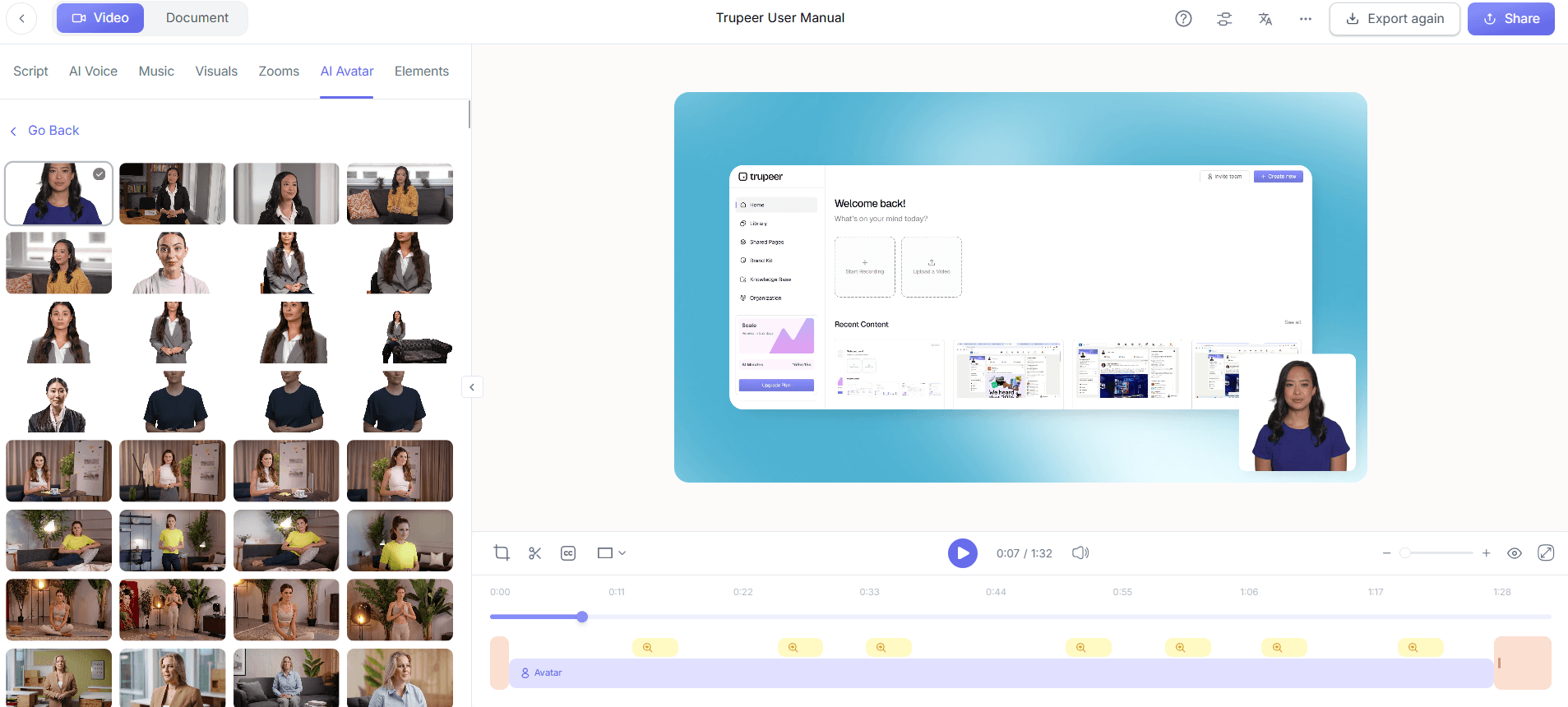
Step 5: Edit and Finalize
Use Trupeer's editing tools to polish your video. Employ automatic filler-word removal to clean up the audio, eliminating unnecessary pauses and words like "um" or "ah." Adjust the video’s pace and tone to match your audience's preferences. This editing phase is crucial for ensuring clarity and professionalism in your final product. Typically, this process can be completed in about 15 minutes, making your video concise and engaging. Trupeer’s easy video editing software for training videos makes this step efficient and user-friendly.
Step 6: Export and Share
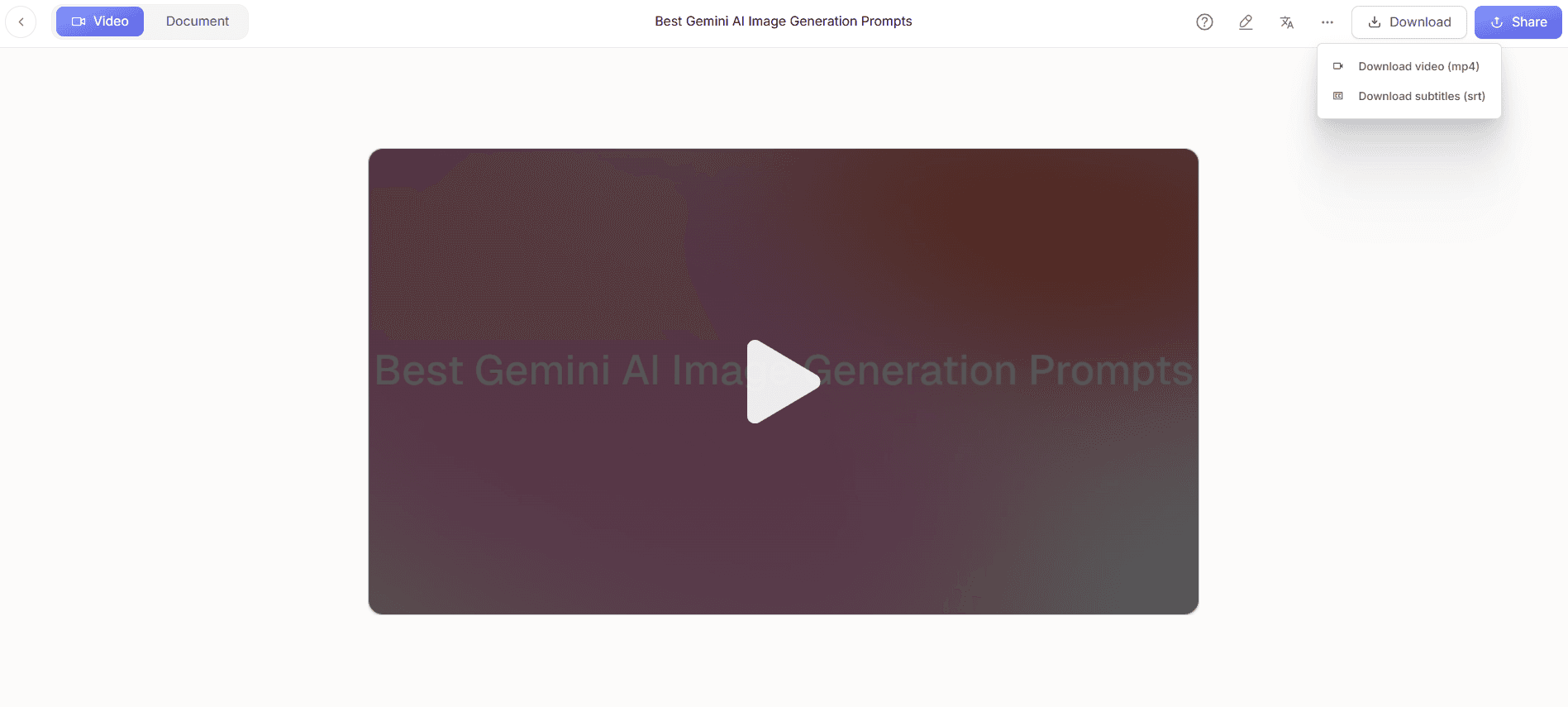
Once your video is refined, export it using Trupeer’s multi-format export options. Choose from formats like MP4, HTML, or PDF, depending on your distribution needs. This versatility ensures your video is accessible across various platforms and devices. Simply click “Export,” select your format, and the video will be ready for sharing in a few minutes. After exporting, you can upload the video to your preferred platforms or share it through Trupeer’s custom-domain hosting. This final step is straightforward, allowing you to distribute your content efficiently.
What tips help you effectively use AI voice cloning for videos?
Using AI voice cloning effectively involves strategic planning and execution. Here are some practical tips to help you get the most out of this technology:
Choose the Right Sample. Start with a high-quality audio sample for cloning. Clear, concise recordings lead to better AI voice accuracy.
Maintain Consistency. Use the same voice across multiple videos to solidify brand identity and ensure a cohesive viewer experience.
use Localization. use AI translation features to adapt your content for global audiences, enhancing engagement across different languages.
Optimize Synchronization. Spend time aligning audio with video precisely. Perfect sync enhances the professionalism of your output.
Test Across Devices. Before finalizing, test your video on various devices to ensure audio clarity and video quality remain consistent.
Focus on Engagement. Use engaging visuals like AI avatars to complement the voiceover. This strategy increases viewer retention.
use Analytics. Monitor viewer engagement through analytics to refine your approach. Data-driven insights help improve future videos.
Teams weighing tools often start with a Loom alternatives comparison before standardizing on a workflow.
When SOPs come into the same conversation, a Scribe alternatives comparison helps clarify the scope.
Frequently asked questions
How does AI voice cloning work?
AI voice cloning uses machine learning to mimic a human voice from a short audio sample. The process involves analyzing the vocal pitch, tone, and inflections in the sample. This data is then used to generate a synthetic voice that sounds similar to the original. The technology allows for customization in terms of pace and tone. It’s particularly useful for creating consistent voiceovers for videos without needing the original speaker. The accuracy of the cloned voice largely depends on the quality of the initial audio sample.
What are the ethical considerations of using AI voice cloning?
AI voice cloning raises several ethical concerns, primarily around consent and privacy. It's crucial to have explicit permission from the individual whose voice is being cloned. Using a voice without consent can lead to legal issues and potential misuse. also, there are concerns about deepfake technology, where cloned voices might be used to deceive or manipulate. Companies using AI voice cloning should establish clear policies and transparency to mitigate these risks. Ethical use ensures trust and maintains the integrity of the technology.
Can AI voice cloning be used in multiple languages?
Yes, AI voice cloning can be adapted for multiple languages. Trupeer, for instance, offers AI translation and dubbing, allowing cloned voices to be used across different languages. This feature is particularly beneficial for businesses operating in global markets. By using language translation capabilities, you can localize content, making it more accessible to a wider audience. However, achieving natural-sounding translations requires careful attention to linguistic nuances and cultural context.
Is it possible to customize the tone and pace of a cloned voice?
Absolutely, customizing the tone and pace of a cloned voice is one of the key benefits of AI voice cloning. Platforms like Trupeer allow users to adjust these parameters to suit different content types. Whether you need a formal tone for corporate presentations or a conversational style for casual tutorials, customization options enable you to tailor the voice to your specific needs. This flexibility ensures that the voiceover aligns with the intended message and audience expectations.
Does Trupeer offer integration with other AI tools?
Yes, Trupeer supports integration with various AI tools, enhancing the functionality of your video content. For instance, Trupeer's AI video translation feature allows for smooth localization, and its integration with AI avatars provides a dynamic visual element. These integrations allow users to create comprehensive and interactive video content without switching platforms. The ability to combine multiple AI features simplifies the production process, making it more efficient and effective.
Related Blogs