4.8/5
Free Documentation Platform for Internal & External Docs
One platform for both internal docs and external docs. Record a workflow once. Trupeer AI generates video plus written documentation that ships as a public Shared Page for customers or a private Shared Page for the team.
Make Docs Free
Trupeer AI's documentation platform handles internal docs and external docs from the same recording, the same brand kit, the same editor. A senior engineer records a deployment walkthrough once. The same content ships as a private Shared Page for the internal runbook library and as a public Shared Page for the customer-facing help article, with visibility settings the team controls per use case. Most teams currently run two parallel documentation stacks: a wiki for internal content (Confluence, Notion, internal SharePoint) and a help center for external content (Intercom Guide, Zendesk, HelpScout Docs). The bottleneck on most teams running parallel stacks is production speed, not stack selection.
One recording produces video plus written documentation, usable as either internal docs or external docs.
Shared Pages visibility settings (public, private, gated) determine internal vs external audience per piece.
Brand kit applies automatically to both internal training content and customer-facing help articles.
Translate into 65+ languages for global teams (internal) or global customers (external) from the same source.
Update by re-recording the changed step. Both internal and external versions stay current at the same URL.
How Trupeer AI handles internal and external documentation in one platform
Most teams keep their internal knowledge base and their external help center on different tools, with different editors, different brand styling, and different update cycles. Trupeer AI handles both production workflows in one place. A support manager records the customer-facing resolution walkthrough; that ships as a public Shared Page in the help center. The same manager records the internal escalation procedure with all the agent-side context; that ships as a private Shared Page in the team's runbook library. Same editor, same brand kit infrastructure, same flow.
What makes the same tool work for both is the Shared Page visibility model. Each generated piece publishes at a hosted URL the team controls: public for content the customer should find via search, private for content only authenticated team members should reach, gated for content meant for a specific authenticated audience. The video player, transcript, and embed options work identically in both modes. Internal documentation gets the same polish as the external documentation, since they come from the same content production pipeline.
How the documentation platform works in three steps
The full flow takes one recording and produces a hosted, ship-ready piece of documentation. No separate writing pass, no video editor, no choice between internal vs external production tools.
Step 1: Record the workflow
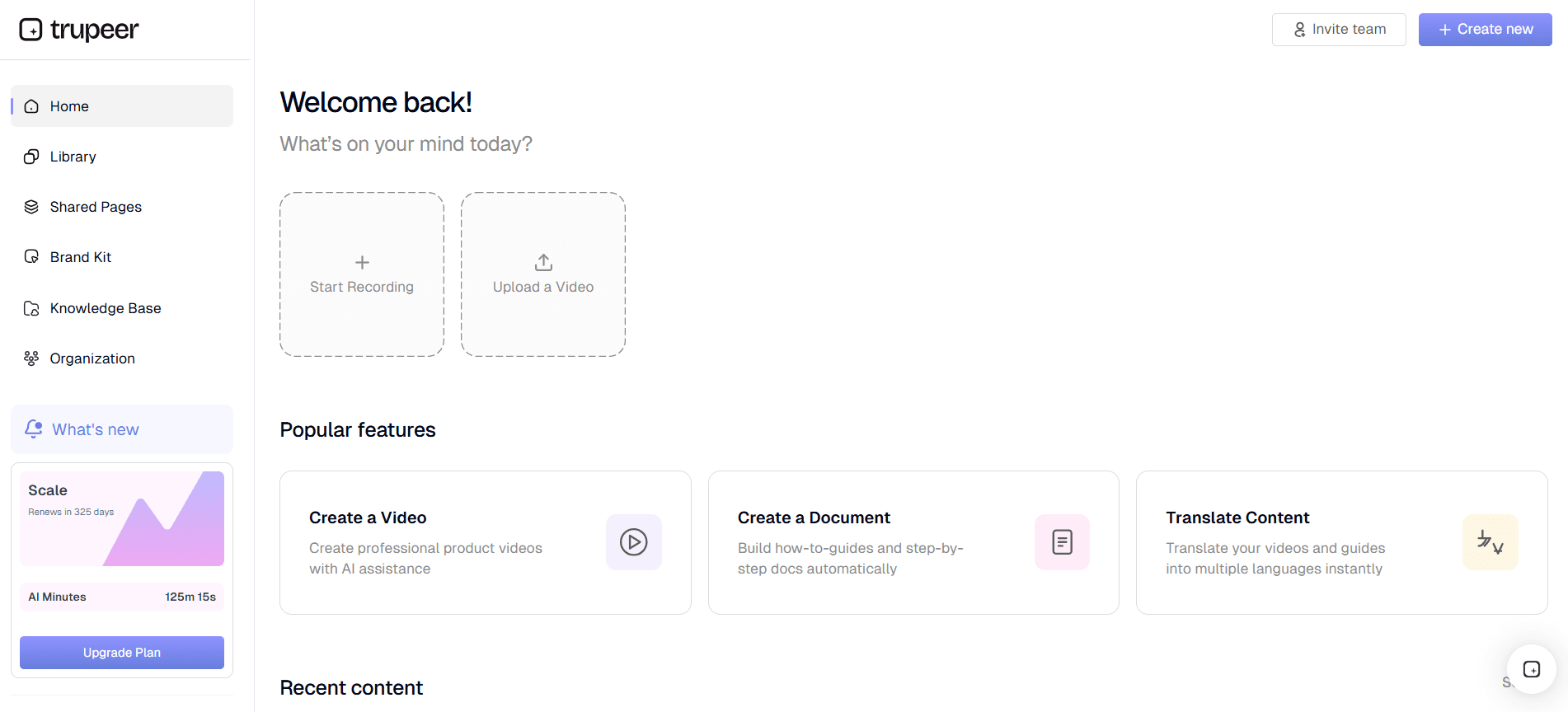
Hit record in the browser, capture the workflow as it's actually performed, or upload an existing screen recording. The AI works on what's recorded. For internal docs this is usually the deployment, the onboarding walkthrough, or the team-specific tool tutorial. For external docs this is usually the customer-facing feature walkthrough or the troubleshooting resolution.
Step 2: Trupeer AI generates video and written documentation
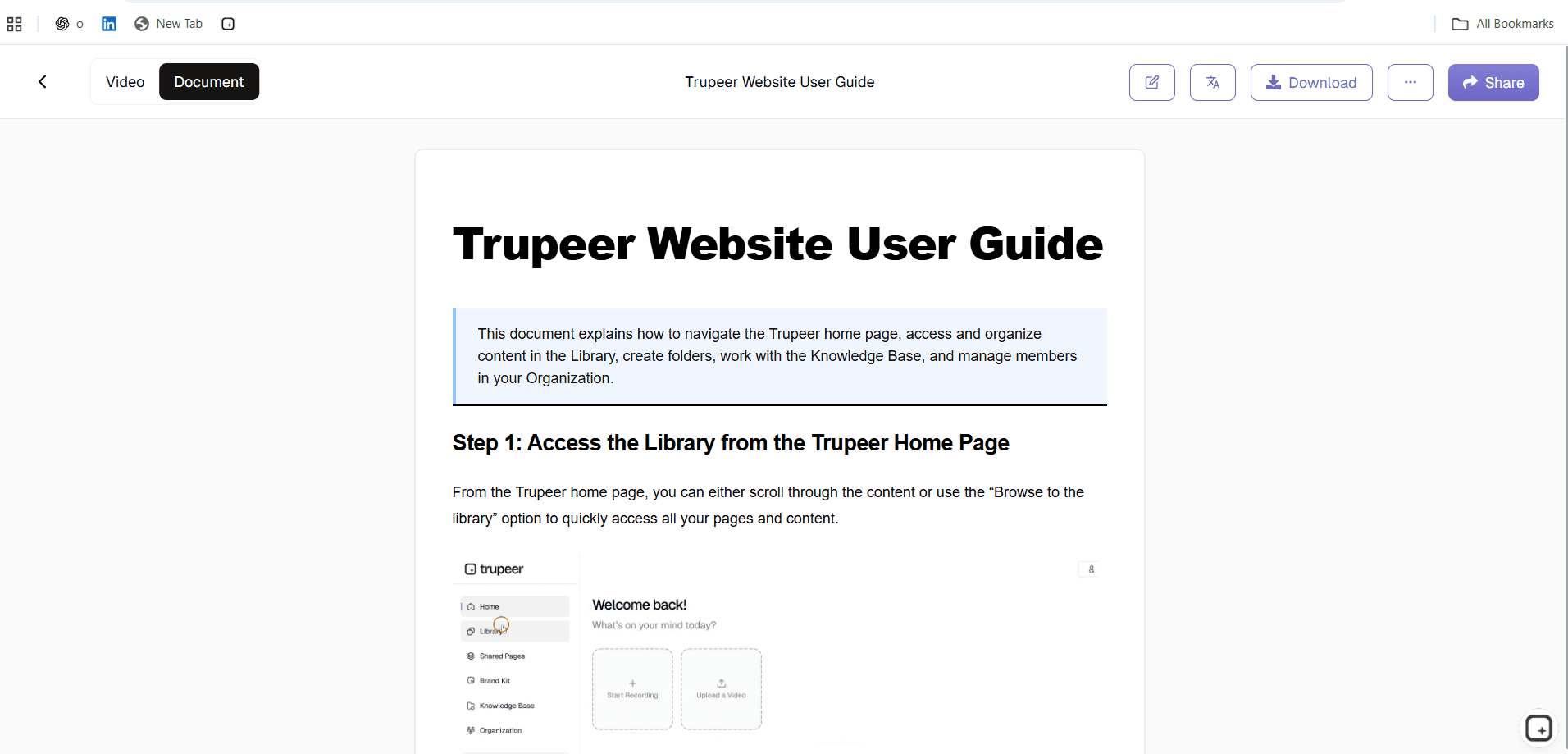
Filler words get removed. Zoom and cursor effects get added where they help the viewer follow the workflow. A draft video and a draft written document show up in the editor together. The custom glossary handles internal product names and feature names that the AI wouldn't otherwise spell or pronounce correctly.
Step 3: Brand, set visibility, and ship
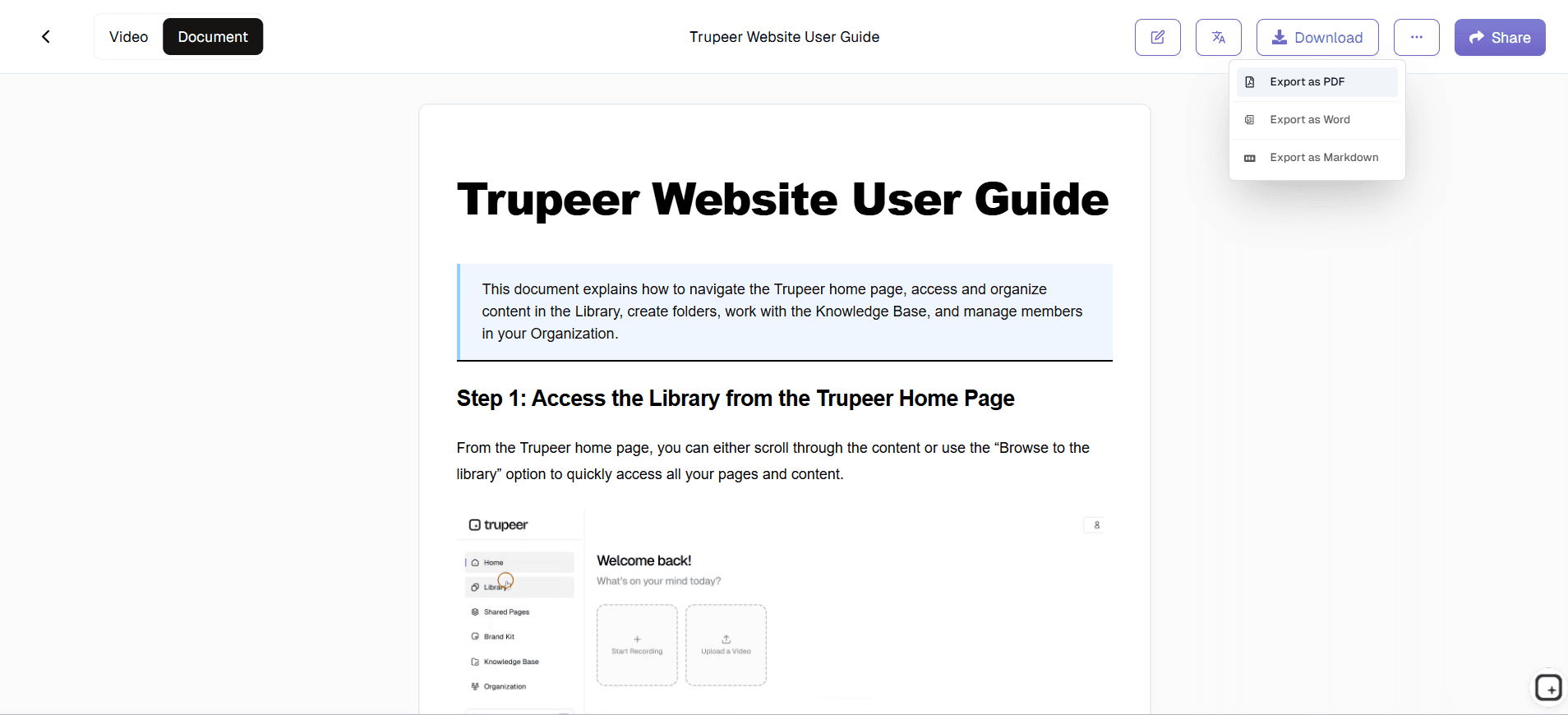
Apply the brand kit so logo, colors, and intro/outro slides match the rest of the team's documentation. Translate into Spanish, Portuguese, Mandarin, Hindi, or any of 65+ languages for global users. Set the Shared Page visibility appropriate to the audience: private for the internal wiki, public for the help center, gated for customer-specific deliverables. Then embed the Shared Page link in whatever existing platform the team uses.
Internal documentation types Trupeer AI handles
Internal documentation usually means the content the team needs but the customer doesn't see: deployment runbooks, on-call procedures, internal tool walkthroughs, onboarding sequences for new hires, team-specific SOPs, escalation guides for support agents, internal training videos. Trupeer AI handles all of these through the same recording-to-doc flow. The output ships as a private Shared Page accessible only to authenticated team members, with the same polish as customer-facing content but with the visibility controls that keep the content where it belongs.
Most teams building an internal knowledge base start with the top three or four workflows that get explained over and over: how to set up a new dev environment, how to handle a specific incident type, how to use a specific internal tool, how to run a recurring meeting type. Producing those four guides as a video plus written companion in one job each, and hosting them at private Shared Page URLs, gets the internal knowledge base off the ground faster than seeding any wiki software, internal wiki software, company wiki software, or corporate wiki software with hand-written entries. From there the team adds more content as gaps surface, which is faster than trying to build a full internal company knowledge base structure upfront. What was previously a multi-quarter internal wiki rollout becomes a steady cadence of one or two new guides per week. The question of what is internal knowledge base content versus what stays in someone's head usually answers itself once production stops being the constraint. Teams asking how to create an internal knowledge base, comparing the best internal knowledge base software, or evaluating free internal knowledge base software usually arrive at this approach by month two, once they see actual internal knowledge base examples that don't take a quarter to build.
External documentation types Trupeer AI handles
External documentation usually means the customer-facing content that lives in a help center, a developer portal, or a public knowledge base: how-to guides for common product workflows, troubleshooting walkthroughs for known issues, getting-started tutorials for new users, feature-specific deep-dives, integration setup guides, and policy explanations. Trupeer AI handles these the same way it handles internal content, with the brand kit ensuring the output matches the rest of the customer-facing assets. The Shared Page hosts the public URL, and the embed code drops into Intercom Guide, Zendesk, HelpScout Docs, or whatever help center the team uses.
The unique benefit on the external side is the translation layer. Customer-facing content can reach customers in Madrid in Spanish, customers in Tokyo in Japanese, and customers in Berlin in German, from the same source recording, in the same week. Translation applies to both the video voiceover and the written documentation, with the brand kit, glossary, and on-screen text carried through. Most help centers treat translation as a quarterly project or skip it entirely. The Trupeer flow makes it a per-recording option that costs no extra production cycle.
Who actually opens this documentation platform
The person who opens this tool is usually a documentation lead, knowledge base owner, or operations manager at a company where the internal wiki and the external help center are both on someone's quarterly OKR list and neither has been updated in months. Consistently, the team knows what content gaps exist on both sides. What they don't have is a tool that handles both production workflows without doubling the work. Trupeer AI consolidates the two workflows into one editor, one brand kit, one content pipeline, with visibility controls determining where each piece lands.
The same workflow shows up across functions. Engineering managers use it to produce internal runbooks for on-call and external changelog explainers for customers. Customer success leaders use it for internal CSM training and external onboarding tutorials. Support directors use it for internal escalation procedures and external help articles. Product managers use it for internal feature briefs and external feature documentation. The internal-and-external split is structural to most documentation work, not a special case. Having one tool that handles both is the actual structural improvement most teams searching for a unified platform are looking for.
Where Trupeer AI fits next to Confluence, Notion, Intercom Guide, and other wiki and help center platforms
Confluence, Notion, SharePoint, and Slab are wiki tools optimized for internal documentation: multi-page hierarchies, internal search, team permissions, page templates. Intercom Guide, Zendesk Guide, HelpScout Docs, and Document360 are help center tools optimized for external customer content: SEO-optimized public articles, customer search, feedback widgets. Trupeer AI is not built to replace either category. It generates the video and written content that goes into both, and provides Shared Page hosting for individual pieces that can also be embedded into the team's existing wiki or help center.
The practical pattern most teams settle on: keep Confluence or Notion as the internal hub where the team's wiki lives. Keep Intercom Guide or Zendesk as the external help center where customer content lives. Use Trupeer AI as the content production layer that feeds both, since the recording flow is identical for both audiences and the editor handles them in one place. Each Trupeer-generated piece becomes either an embedded video in a Confluence page (internal) or an embedded video in a help center article (external), with the Shared Page URL itself serving as a standalone link the team can paste anywhere. The wiki and help center stay as the discovery and navigation layers; Trupeer handles the upstream production. Pairing this flow with the Trupeer AI SOP builder covers the standard operating procedures that sit underneath the recorded workflows.
Why teams use Trupeer AI for both internal and external documentation
One tool, two audiences
Internal runbooks and external help articles use the same recording flow, the same editor, the same brand kit. Visibility settings control where each piece lands.
Private Shared Pages for internal content
Internal documentation hosts at private Shared Pages accessible only to authenticated team members. Same polish as customer-facing content.
Public Shared Pages for external content
External help articles host at public Shared Pages and embed into Intercom Guide, Zendesk, HelpScout Docs, or any help center the team uses.
Create internal and external documentation in three steps
Step 1
Record the workflow on screen or upload existing footage
Step 2
Trupeer AI generates the video and written documentation
Step 3
Brand, set visibility (public or private), and ship
Frequently Asked Questions
Is the documentation platform free to use?
Yes for the core flow. Record a workflow, generate the video and written documentation, and share via a Shared Page link without paying. Paid tiers add brand kits, AI avatars, custom voice cloning, team workspaces, translation across 65+ languages, and longer recording limits. Pricing details on the pricing page.
What's the difference between internal documentation and external documentation in Trupeer?
The difference is the Shared Page visibility setting, not the production flow. Internal documentation publishes as a private Shared Page accessible only to authenticated team members, useful for runbooks, SOPs, internal training, and team-specific tooling. External documentation publishes as a public Shared Page accessible to anyone with the URL, useful for help center articles, customer-facing tutorials, and public-facing how-to guides. Both come from the same recording-to-doc flow, the same editor, and the same brand kit. The team picks visibility per piece.
Does Trupeer AI replace our existing wiki (Confluence, Notion) or help center (Intercom, Zendesk)?
No. Confluence, Notion, and other wiki tools handle multi-page hierarchies, internal search, and team permissions for internal documentation. Intercom Guide, Zendesk, and other help center tools handle public articles, customer search, and SEO for external documentation. Trupeer AI doesn't replace either category. It generates the video and written content that lives inside those tools, with each generated piece available both as an embed (for the wiki or help center page) and as a standalone Shared Page URL.
What inputs and outputs does the platform support?
Inputs: screen recordings, webcam recordings, uploaded video files (including Zoom recordings), audio files, and text scripts. Outputs: video as MP4 and written documentation as PDF or Word (DOCX). Each piece also ships as a Shared Page: a hosted URL with logo, CTA, video player, transcript, timed comments, embed options, and visibility settings. Translation in 65+ languages applies to both video and document in the same job.
Can the same content be both internal and external?
Yes. The team can publish the same recording at multiple Shared Page URLs with different visibility settings: a private internal version with the agent-side detail, and a public external version with the customer-facing framing. The team makes the edits between versions in the Trupeer editor (removing internal-only steps, adjusting tone, applying a different brand variant). Both versions update in place when the team re-records changed sections.
More Tools