4.8/5
Free Documentation Platform with Multimedia Support
One screen recording produces a written document with screenshots and GIFs, a parallel MP4 video, and a Shared Page that hosts both together. The documentation platform built for multimedia from the source recording up.
Generate Multimedia Documentation Free

Trupeer AI is the documentation platform with multimedia support that produces three formats from one screen recording: a written document with embedded screenshots and GIFs, a parallel MP4 video with voiceover, and a Shared Page that hosts both together for the reader. The text-only platforms (Confluence, Notion, GitBook, BookStack) ask teams to add multimedia after the fact, when someone has time, which usually means never. The video-only tools (Loom, Vidyard, ScreenPal) produce the recording but leave the written version as a separate writing job. Producing both formats has historically meant double the work, which is why most teams ship one format and abandon the other.
One screen recording produces a written document, a parallel MP4 video, and a Shared Page in the same job.
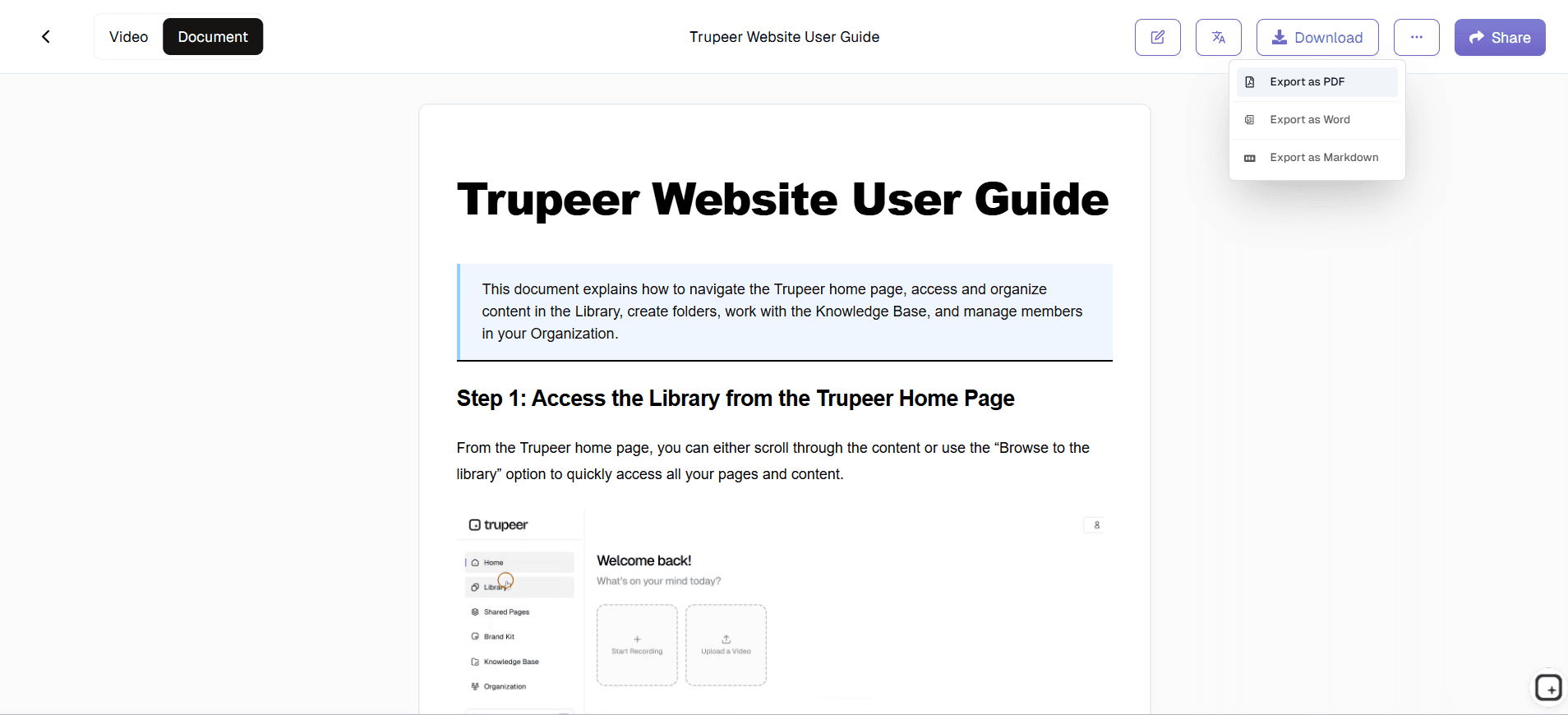
The document contains text, embedded screenshots, and GIFs. The video is a separate MP4 file with voiceover.
Shared Page hosts the video player and the document together at one branded URL.
Translation into 65+ languages applies to both the video voiceover and the written document.
Update by re-recording the changed step. The video, the document, and the Shared Page all stay in sync.
What multimedia means in Trupeer AI documentation
The word multimedia gets stretched thin in documentation marketing. Most documentation platforms with multimedia support mean text with a few static images, maybe a YouTube embed if the team got around to it. Trupeer AI defines multimedia as three formats that ship together from a single screen recording. One is the written document, exported as PDF or DOCX, with text, headings, numbered steps, embedded screenshots from the recording, and embedded GIFs for the parts of the workflow where motion matters more than a still frame. Another is the parallel MP4 video file, with AI voiceover, filler-word cleanup, zoom effects on the parts of the screen that need attention, and brand kit applied. The third is the Shared Page: one branded URL where the video player and the written document live together, with the brand logo at the top and the company's CTA at the bottom.
Treating multimedia as a three-format stack instead of as text-with-extras matters because different readers want different formats. A customer success manager preparing for a call wants the written document with numbered steps. The new hire skimming the help center wants the video. A customer in a hurry wants the GIF embedded in the article. Shipping all three from one recording lets the documentation team serve all three without producing three separate artifacts. The same brand kit, the same glossary for product names, and the same translation set apply to every output.
How the multimedia documentation platform works in three steps
One recording, three formats, one Shared Page link. No separate video editor, no separate writer, no copy-paste between tools.
Step 1: Record once
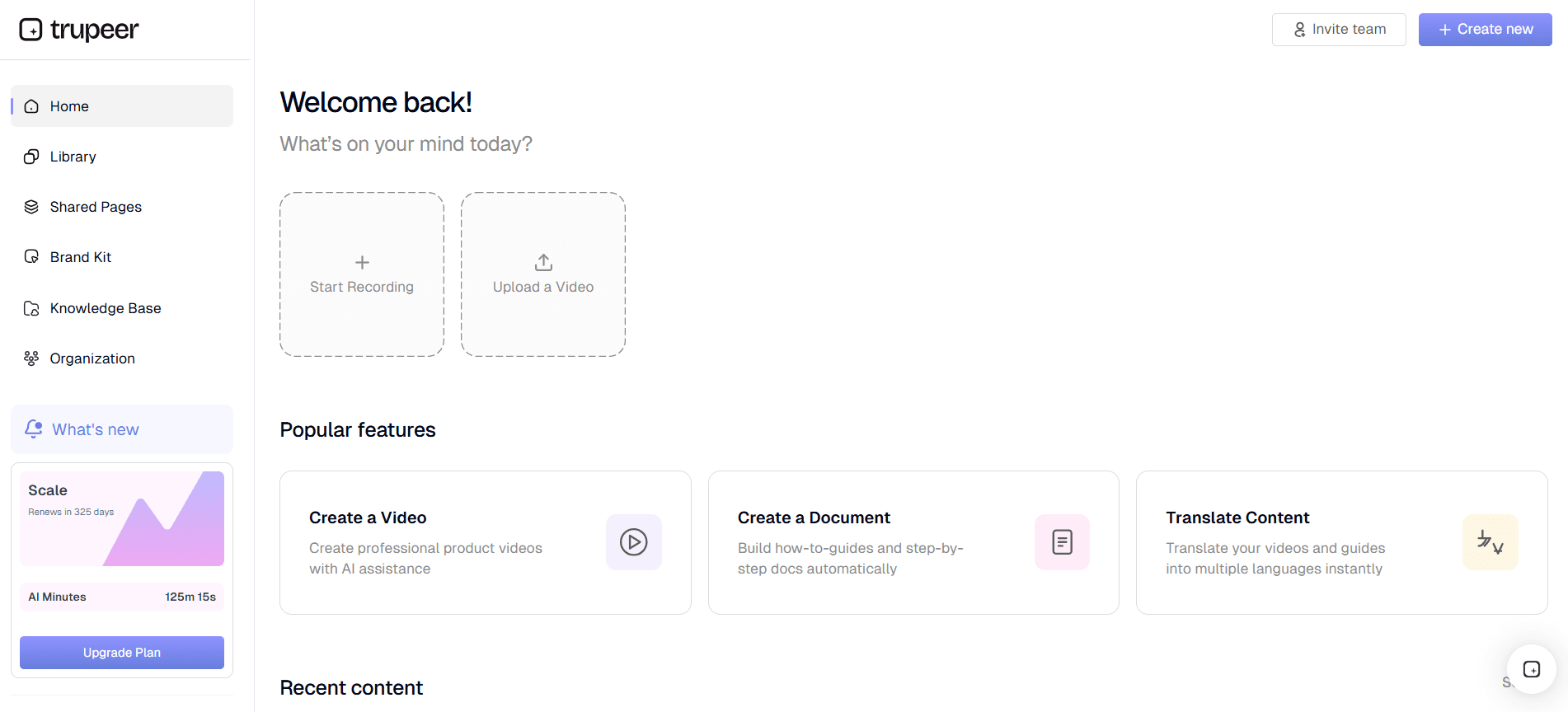
Hit record in the browser or upload an existing video file (Zoom recordings work too). Walk through the workflow, the integration setup, the troubleshooting steps, or whatever needs to be documented. The recording is the source for every format produced downstream.
Step 2: Trupeer AI generates the document, video, and visual assets
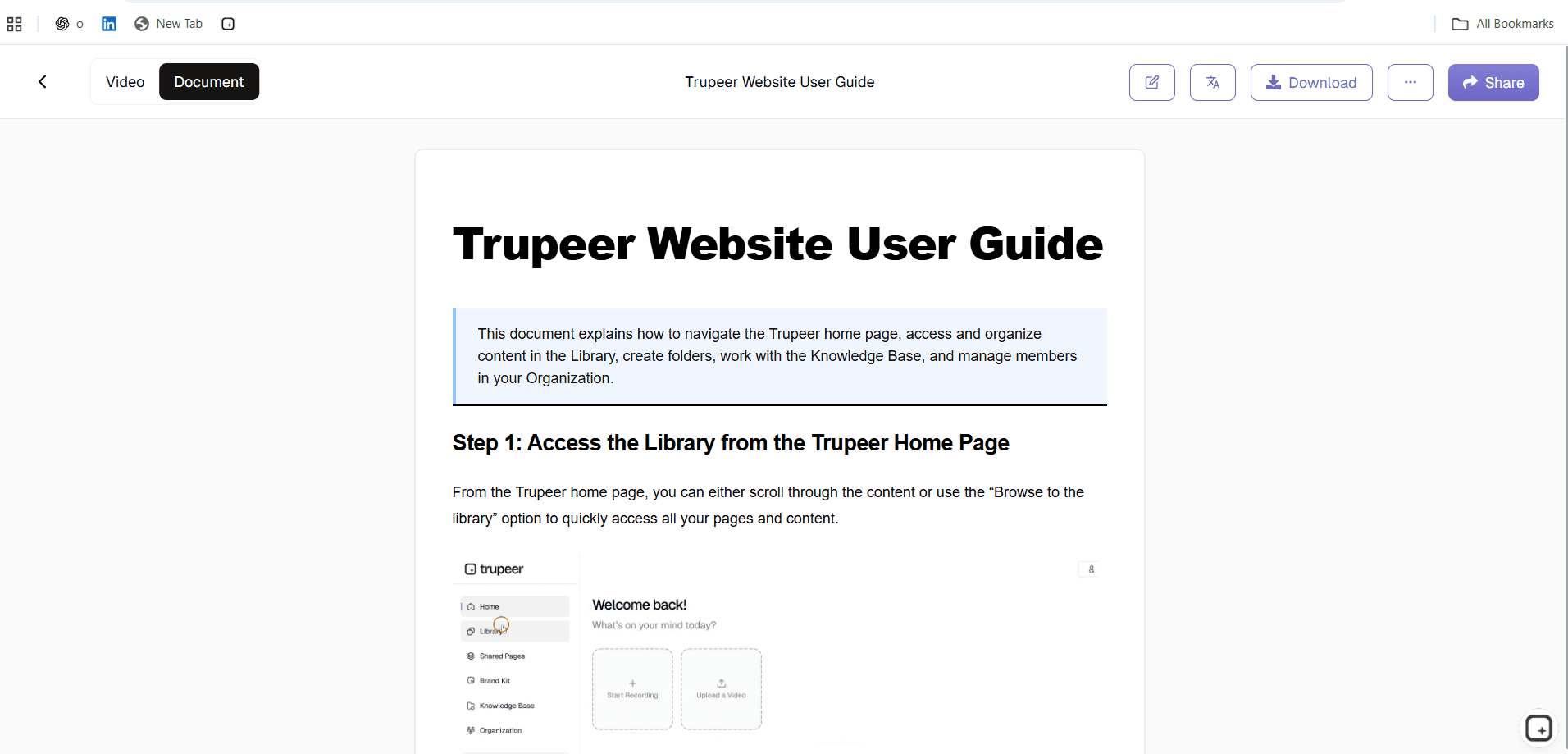
AI processes the recording. Filler words get removed. Zoom and cursor effects highlight the parts of the screen the reader needs to focus on. Screenshots get extracted at the right moments for the document. GIFs get generated for the multi-step interactions where a still image loses the meaning. A written document and an MP4 video appear in the editor together.
Step 3: Brand, translate, and publish to a Shared Page
Apply the brand kit so logos, colors, intro and outro slides match the rest of the documentation library. Translate into Spanish, German, Japanese, Hindi, or any of 65+ languages, with the video voiceover and the written document both translated in the same job. Publish to a Shared Page, which is a branded URL where the video player and the document live together for the reader.
Who opens a documentation platform with multimedia support
Technical writers and documentation managers at SaaS companies open this tool first. Consistently, the request from the team is the same: we have a documentation site that needs more multimedia, customers ask for videos in the help center, trainers want walkthrough videos to pair with the SOPs, but no video editor sits on staff. Trupeer AI removes the need for a video editor by handling post-production automatically.
Customer education teams use it to produce the video-plus-article combination most modern help centers expect. Product marketing teams use it for feature announcement pages where a video and a written explainer need to ship together. Customer success teams use it for onboarding content where the customer might want to read or might want to watch, depending on their preference. Engineering managers use it for internal documentation of operational procedures where the video shows the actual tool and the document captures the steps for future reference. Knowledge base owners use it for the long tail of help articles where each one needs both formats but nobody has time to produce two artifacts per ticket.
Content types the multimedia documentation platform handles
Help center articles, product walkthroughs, training videos, SOPs, onboarding flows, integration setup guides, troubleshooting walkthroughs, release notes for new features, internal process documentation, customer-facing FAQs, and developer documentation for technical users all run through the same recording-to-document flow. The format adjusts to fit the channel. A help center wants the long-form written article with screenshots and an optional video at the top. The YouTube support channel wants the MP4. A Slack help bot wants a Shared Page link that opens the full multimedia view. The printed onboarding handout wants the PDF.
For documentation platforms with video support more broadly, Trupeer AI is a content production tool, not a hosting one. Confluence, Notion, GitBook, BookStack, and similar tools handle the hosting layer well enough; what they don't do is produce the multimedia content that fills their pages. Most documentation tools with multimedia support assume the team will produce the videos and screenshots somewhere else and embed them in. Trupeer AI inverts this assumption: the multimedia documentation tool produces the video, the screenshots, the GIFs, and the written document, then ships to whatever hosting platform the team already uses. Teams that want a documentation platform with video built in (rather than added in afterward) use the Shared Page itself as the customer-facing destination; for everyone else, the PDF/DOCX and MP4 outputs slot into the existing documentation site. The same approach handles video documentation, documentation with video walkthroughs embedded next to written steps, and documentation with multimedia formats across every page.
Where Trupeer AI fits next to Confluence, Notion, Loom, and other tools
Documentation platforms split into two camps. The text-first camp (Confluence, Notion, GitBook, BookStack, ReadMe, Document360) handles structured writing well but treats multimedia as a bolt-on. The video-first camp (Loom, Vidyard, ScreenPal, Tella) handles recording well but treats the written documentation as someone else's problem. Trupeer AI produces both formats from one recording, which is what teams actually need when they say they want a documentation platform with multimedia support.
The integration with existing platforms is straightforward. Teams hosting in Confluence or Notion download the document and video from Trupeer AI and upload to the existing space. Anyone using GitBook or ReadMe links out to the Shared Page from inside the article. Teams without a documentation hosting tool yet use the Shared Page itself as the customer-facing destination. The format flexibility matters because documentation teams rarely get to pick their hosting platform from scratch; they inherit one and need a way to produce multimedia content that fits into it.
Update and translate multimedia documentation as the product changes
Multimedia documentation rots faster than text-only documentation because every visual element ties to a specific version of the product UI. A redesign breaks the video, the screenshots, and the GIFs together. Most teams handle this by quietly letting the multimedia drift and apologizing to customers who notice. Trupeer AI handles updates by re-recording the changed step. The AI re-processes only that segment. Both the video and the written document update in place, and the Shared Page reflects the current version automatically for anyone who has the link.
For global customer bases, translation closes the language gap on all multimedia formats at once. The video voiceover translates, the written document translates, on-screen text gets handled, and the brand kit and glossary carry through. A help article that exists in English by Friday can exist in Spanish, Portuguese, German, Japanese, Hindi, and Mandarin by the following Monday, with the same video and written document combination in every language. Pairing the multimedia documentation platform with the Trupeer AI SOP builder covers both the customer-facing multimedia documentation and the internal procedures that sit underneath it.
Why teams use Trupeer AI for multimedia documentation
Document, video, and Shared Page from one recording
One screen recording produces a written document with embedded screenshots and GIFs, a parallel MP4 video with voiceover, and a branded Shared Page that hosts both together for the reader.
Built for multimedia, not bolted on
Unlike text-first platforms (Confluence, Notion, GitBook) that treat video as an embed afterthought, the multimedia formats here ship from the same source recording, in the same job, with the same brand kit applied throughout.
Translation across all multimedia formats at once
65+ languages applied to the video voiceover and the written document together, with brand kit and glossary carried through every output.
Generate multimedia documentation in three steps
Step 1
Record the workflow or upload existing footage
Step 2
Trupeer AI generates the document, video, screenshots, and GIFs
Step 3
Brand, translate, and publish to a Shared Page
Frequently Asked Questions
Is the multimedia documentation platform free to use?
Yes for the core flow. Record a workflow, generate the document, the MP4 video, and the Shared Page, and share without paying. Paid tiers add brand kits, AI avatars, custom voice cloning, team workspaces, translation across 65+ languages, and longer recording limits. Pricing details on the pricing page.
Are videos embedded directly inside the document file?
No. The document file (PDF or DOCX) contains text, embedded screenshots, and embedded GIFs. The video is a separate MP4 file that ships alongside the document. Both formats appear together on the Shared Page, which is a branded URL where the video player and the document live for the reader. This is the honest answer; documentation tools that claim to embed playable video inside a downloadable PDF are usually showing a screenshot with a play button overlay that links out to a hosted video.
What multimedia formats does Trupeer AI produce?
Written documents as PDF and DOCX with text, embedded screenshots, and embedded GIFs. Video as MP4 with voiceover, brand kit, and translation applied. The Shared Page hosts both formats at one branded URL with the company logo and CTA. Trupeer AI does not produce WebM video, SVG diagrams, animated flow diagrams, or interactive hotspot overlays.
Can Trupeer AI replace our existing documentation platform (Confluence, Notion, GitBook)?
Not really. Trupeer AI is a multimedia content production tool, not a documentation hosting platform. Teams already on Confluence, Notion, GitBook, BookStack, ReadMe, or Document360 keep that platform for hosting and use Trupeer AI to produce the video and document content that goes into it. Teams without a documentation host can use the Shared Page itself as the customer-facing destination, or pair Trupeer AI with the Trupeer AI knowledge base for the hosting layer.
How does multimedia documentation handle product updates?
Re-record just the changed step. Trupeer AI re-processes only that segment. The video, the screenshots, the GIFs, and the written document all update in place. The Shared Page reflects the current version automatically for anyone with the link. This is the same workflow whether the documentation has 1 multimedia page or 200.
More Tools