4.8/5
Free Internal Documentation Platform
The internal documentation platform multiple teams use to produce internal-only content (process docs, SOPs, runbooks, onboarding guides) that sits behind the firewall, with brand kits, translation, and visibility controls built in.
Start Internal Docs Free
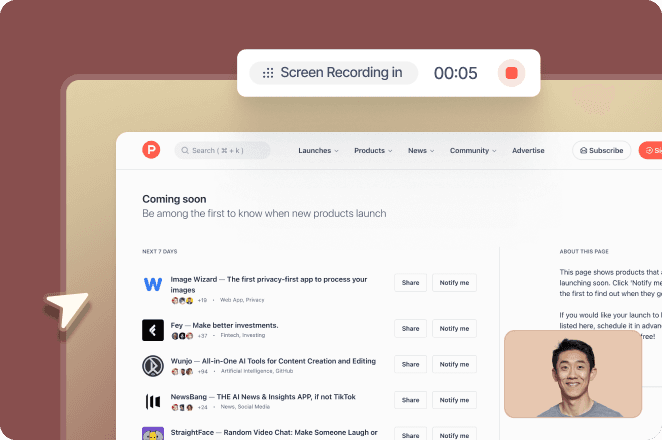
Trupeer AI is the internal documentation platform for companies producing internal-only content (process docs, SOPs, onboarding guides, system runbooks, internal training, post-mortems) that lives behind the corporate firewall and never reaches customers. Multiple teams across the org generate the actual content (video plus written guide together) from one workspace, with brand kits enforcing visual consistency and the custom glossary handling internal product names and acronyms. Output ships as MP4 video, PDF or Word document, or a branded Shared Page link configured for organization-only visibility. Most internal documentation efforts know exactly what they need to document; the constraint is the writing time per document, which used to take half a day per walkthrough and which queues 30 deep on a single ops or L&D person's plate.
Generates internal documentation (video plus written guide together) from one screen recording or AI avatar script.
Organization-only visibility built in via Shared Pages, so internal docs stay internal.
Sits next to Confluence, Notion, SharePoint, and Slab. Output drops into those, or onto Trupeer-hosted Shared Pages.
Brand kits and custom glossary enforce visual and terminology consistency across teams.
Translation across 65+ languages for multinational workforces.
What this internal documentation platform produces
An employee on any team (an HR onboarding lead, an IT system administrator, an ops manager, a senior engineer, a finance team trainer) opens the tool and starts a screen recording. Or, if recording isn't an option, types a script and picks an AI avatar from the catalog to deliver the content as a talking-head video. Trupeer AI handles post-production. Filler words go, zoom and cursor effects highlight what the viewer needs to see, and a draft video plus a draft written internal documentation page arrive in the editor together with screenshots and numbered steps inline.
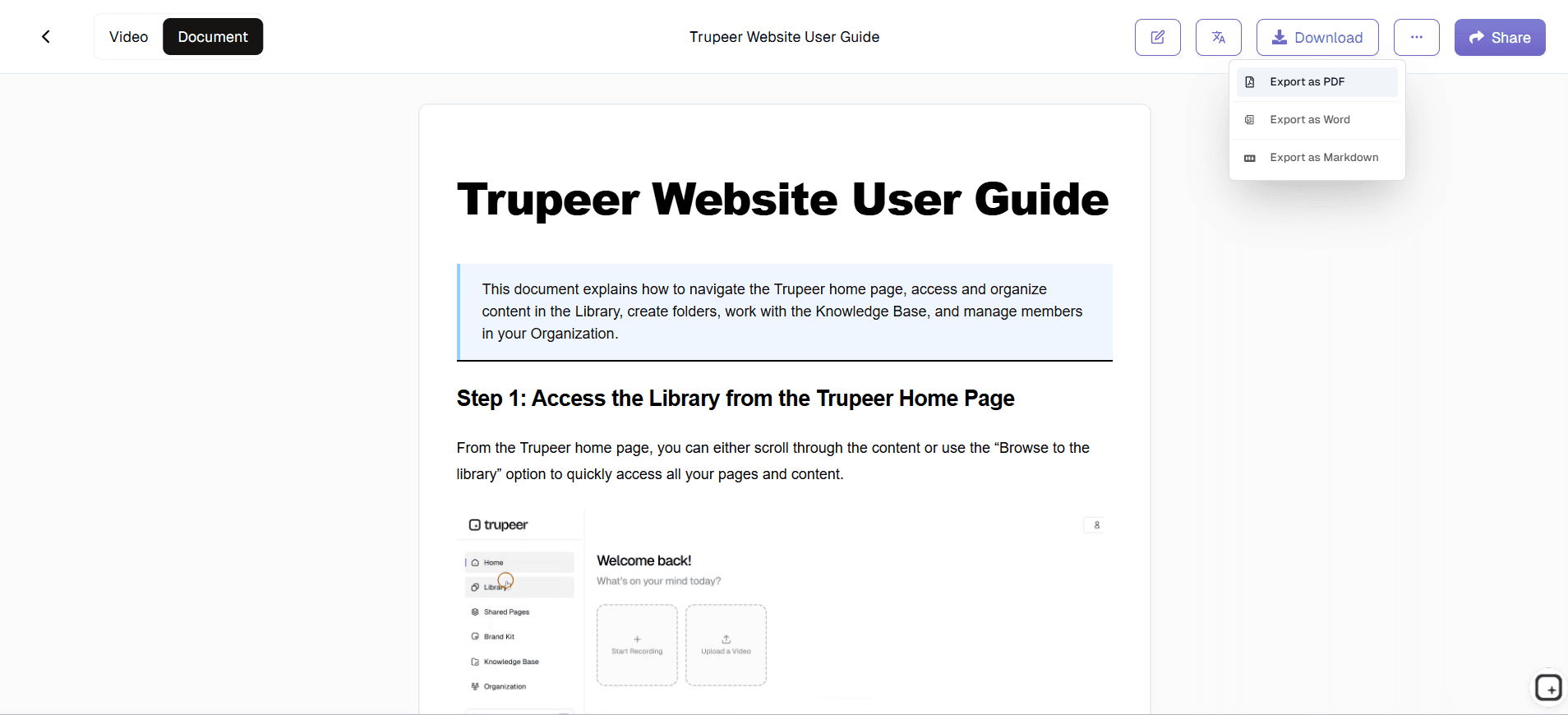
Video output is MP4. Document output is PDF or Word, both ready to paste into Confluence, Notion, SharePoint, Slab, the internal wiki, the employee handbook, or wherever the org currently stores internal documentation. The Shared Page option wraps both formats into one branded link with organization-only visibility, which works as the native internal documentation host when the org doesn't already have a Confluence or Notion deployment. Brand kit applies automatically across every output (logo, colors, fonts, intro and outro slides), and the custom glossary catches internal product names, system acronyms, and the company-specific terminology the AI wouldn't otherwise spell correctly. Compared to traditional internal documentation software or any general-purpose internal documentation tool, the pairing of video plus written guide from one source recording is the part most teams miss when picking between internal documentation tools.
How the internal documentation platform works in three steps
Three steps cover the production flow. The platform doesn't replace the team's existing internal wiki or knowledge base. It produces content that goes into it.
Step 1: Record the walkthrough or use an AI avatar
Start a screen recording in the browser, on any corporate-issued laptop. Or skip the recording entirely: type a script and pick an AI avatar from the catalog (or use a custom avatar trained on a specific person's likeness via the HeyGen integration). The avatar route handles internal documentation cases where the subject expert can't record or where the team wants a consistent presenter across the whole internal documentation library.
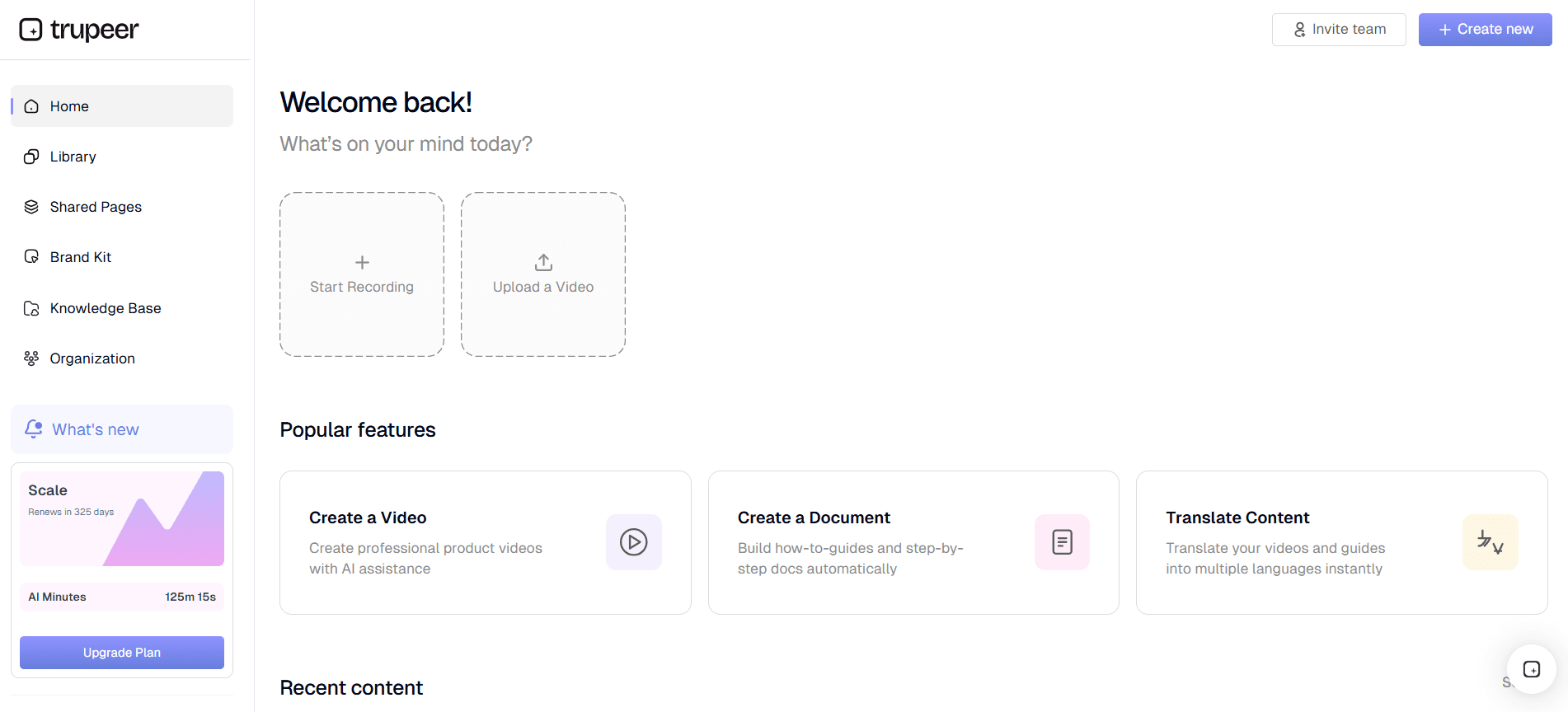
Step 2: Trupeer AI generates the video and written internal documentation
Post-production runs automatically. Filler words and pauses get removed. Zoom and cursor effects highlight the part of the screen the viewer needs to see. A draft video and a draft written internal documentation page arrive in the editor together, with screenshots and numbered steps inline. The custom glossary catches internal product names, system acronyms, and team-specific jargon before they get transcribed wrong.
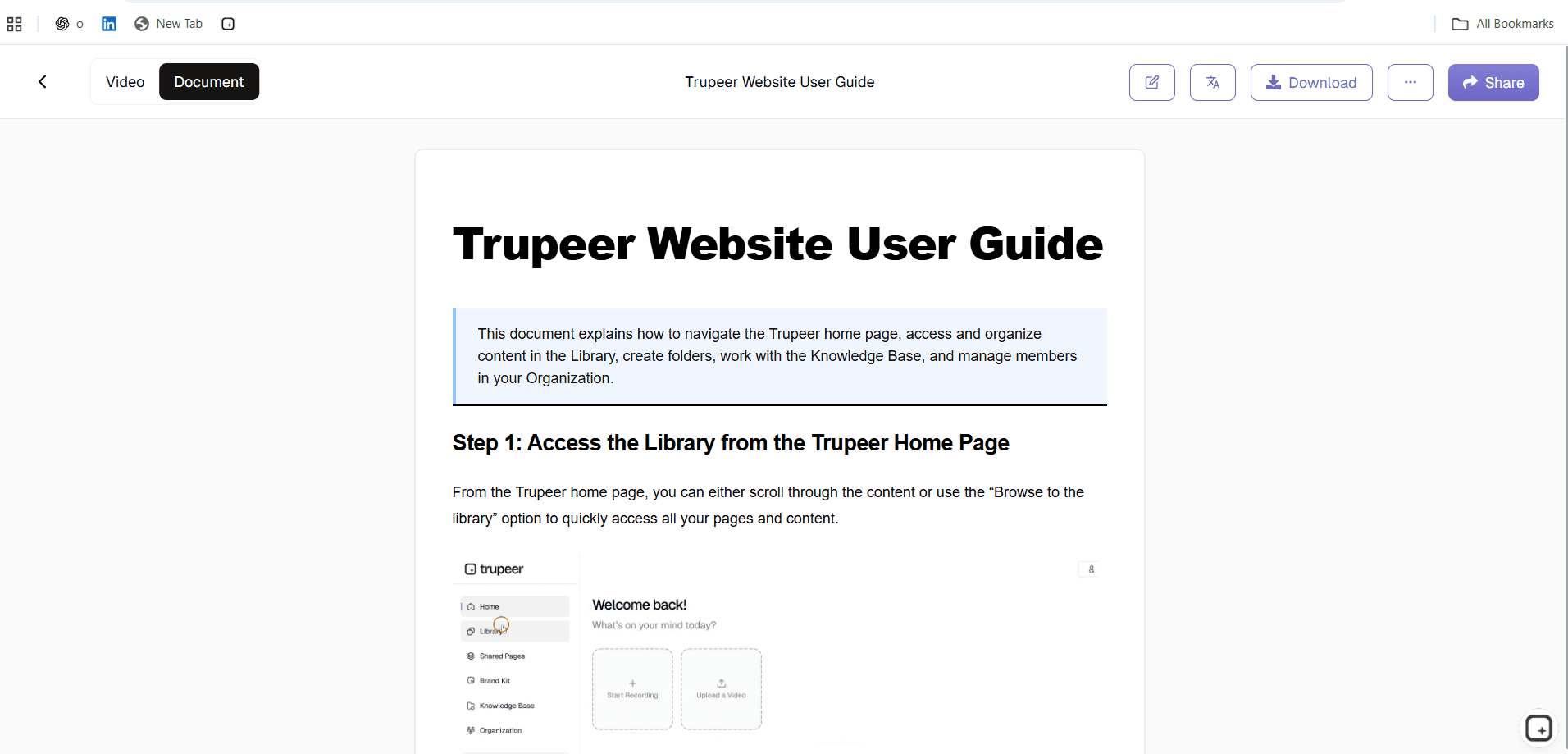
Step 3: Brand, restrict visibility, ship
Apply the brand kit so internal documentation matches the rest of the org's internal content library. Configure Knowledge Base visibility (organization-only, selected domains, or invite-only) to ensure internal docs stay internal. Then ship via Shared Page link, paste the PDF into Confluence or Notion, attach the MP4 to a SharePoint page, or embed the link in Slack.
Who runs internal documentation efforts at this volume
The person who runs internal documentation efforts inside an organization is usually a head of operations, a knowledge management lead, an L&D specialist, a chief of staff, or whichever ops-heavy generalist got stuck with "document everything" as a quarterly OKR. They have a backlog of internal documentation requests from different teams, no dedicated technical writer, and a hard deadline tied to a system rollout, a compliance window, or an onboarding cohort starting Monday. They open this tool when the existing approach (typing documentation manually in Confluence or Notion, taking screenshots manually, and embedding them inline) physically cannot ship the volume of internal documentation the business has asked for.
Around them, individual teams produce their own internal documentation in the same workspace. HR handles new-hire onboarding modules and policy walkthroughs. IT documents system access procedures, the new SSO flow, the VPN setup. Operations documents process SOPs for finance, supply chain, and procurement. Engineering documents deployment runbooks and architecture decisions. Sales enablement documents internal product training and competitor research workflows. Customer success documents internal tools training for customer-facing roles. Production analytics in the admin view show how much internal documentation each team has shipped, which helps the knowledge management lead see actual content velocity per function.
Internal documentation content types this platform handles
The content types that come up most often in internal documentation work: onboarding modules (the system tour, the policies overview, the first-week orientation), system rollout documentation (the new HRIS, the new CRM, the new tool stack), process SOPs (how to close the books, how to onboard a vendor, how to file an expense), runbooks for engineering and operations (the deploy procedure, the 3am incident escalation, the disaster recovery flow), and compliance documentation (the annual data privacy refresher, the security awareness module). Trupeer AI handles all of these from the same recording-to-document flow. The format adjusts to fit the audience: a process SOP wants numbered steps with screenshots, an architecture walkthrough wants the video with the written summary, a compliance refresher wants both side by side.
For organizations running internal documentation programs across many teams concurrently, the platform's value compounds across departments. A single L&D specialist or knowledge manager working with Trupeer can produce the per-document output that previously required a small in-house writing team or an ongoing relationship with a documentation contractor. Across a 1,000-employee org with 5 to 10 active internal documentation streams running concurrently (engineering onboarding, ops SOPs, IT system rollouts, sales enablement, compliance), the per-document production time drops from one to three days down to one to two hours. This is where company documentation and team documentation efforts diverge from one-off process documentation work: the volume and consistency requirements shift, and internal documentation management starts mattering as much as production speed. For dual-audience scenarios where the same source content needs to ship externally as well as internally, the internal and external documentation platform covers both sides.
Where Trupeer fits next to Confluence, Notion, SharePoint, and the team's existing wiki
Trupeer AI is not a wiki or knowledge management system. Confluence, Notion, SharePoint, Slab, GitBook, Coda, and Tettra all handle the hosting layer: pages, spaces, nesting, search, permissions, comments, version history with diff comparison, and the structured taxonomy that internal documentation libraries depend on. Trupeer AI sits at the content production layer behind those systems. The org's ops team, L&D lead, or knowledge manager produces internal documentation in Trupeer and pastes the output into whichever wiki the company already runs. The MP4 and PDF formats work with every wiki, so the choice of wiki doesn't constrain the tool.
Trupeer's own Knowledge Base feature acts as a native internal knowledge base hosting option for orgs that don't already run Confluence or Notion (or that want to keep some internal documentation entirely on Trupeer's domain). Visibility settings cover the spectrum: public for content that should be web-indexable, organization-only for true internal documentation, selected domains for partner and vendor access, invite-only for restricted content. Most orgs use both setups together: the bulk of internal documentation lives in the existing wiki and Trupeer-produced content goes there, while a smaller subset (training videos, walkthrough recordings, onboarding tours) lives on Trupeer-hosted Shared Pages because the rich video experience works better on a native player than embedded inside a wiki page. For teams choosing an internal documentation system from scratch, the Trupeer-hosted option avoids the wiki-procurement step entirely.
Translation, updates, and the multilingual workforce
Internal documentation rots fast because the systems and processes it documents change every quarter. A UI update breaks the system walkthrough, a process change makes the SOP misleading, a re-org changes the escalation path described in the runbook. Most internal documentation efforts handle this by quietly letting the wiki drift and answering the questions on Slack each time someone hits the outdated page. Trupeer AI handles updates by re-recording just the changed step. The AI re-processes only that segment, both the video and the written document update in place, and the next person to look at the wiki page sees the current version.
For multinational workforces, translation closes the language gap that usually limits how broadly internal documentation actually gets used. The same SOP, runbook, or onboarding walkthrough reaches employees in Mumbai in Hindi, Berlin in German, Mexico City in Spanish, and Tokyo in Japanese, from the same source recording, in the same release cycle. Translation applies to both the video voiceover and the written document, with brand kit, glossary, and on-screen text carried through. Pairing this internal documentation platform with the Trupeer AI SOP builder covers the standard operating procedures that sit underneath most internal documentation libraries.
Why teams use Trupeer AI as their internal documentation platform
Video and written internal documentation in one pass
One recording (or one AI avatar script) generates both an MP4 walkthrough video and a written internal documentation page with screenshots and numbered steps, from the same source.
Organization-only visibility for internal-only content
Shared Pages support public, organization-only, selected domains, and invite-only visibility settings. Internal documentation stays internal, with link-level controls that match what compliance and IT actually expect.
Sits alongside Confluence, Notion, and SharePoint
Output drops directly into the team's existing internal wiki or knowledge base. Trupeer doesn't replace the wiki; it produces the content faster than a writer can.
Build internal documentation in three steps
Step 1
Record the walkthrough or type a script for an AI avatar to deliver
Step 2
Trupeer AI generates the video and written internal documentation
Step 3
Brand, set organization-only visibility, ship to the wiki or Shared Page
Frequently Asked Questions
Is the internal documentation platform free to use?
Yes for the core flow. Record a walkthrough or use an AI avatar, generate the video plus written internal documentation page, share via a Shared Page link without paying. Paid tiers add brand kits, custom voice cloning, AI avatars from the full catalog, team workspaces, translation across 65+ languages, knowledge base visibility controls, production analytics in the admin view, and longer recording limits. Pricing details on the pricing page.
Does Trupeer integrate with Confluence, Notion, SharePoint, or our existing wiki?
Not natively as a real-time sync. Trupeer AI exports the internal documentation as a PDF or Word document and the video as an MP4, which the team uploads to Confluence, Notion, SharePoint, Slab, GitBook, or wherever the org currently stores internal documentation. The Shared Page option also generates a branded link that embeds inside any of those wikis as an inline player. Trupeer doesn't push content directly into the wiki via API, and doesn't sync edits back from the wiki.
How do we keep internal documentation internal?
Knowledge Base visibility settings control access. Public makes the content web-indexable (useful for external help center work but not internal documentation). Organization-only restricts access to authenticated members of the org. Selected domains restricts to specific email domains (useful for partner and vendor access). Invite-only restricts to a named list. For most internal documentation work, organization-only is the right default. Security and data handling details on the trust center.
What inputs and outputs does the platform support?
Inputs: screen recordings (browser-based), webcam recordings, uploaded video files (including Zoom recordings), audio files, text scripts, and AI avatar deliveries. Outputs: video as MP4 and internal documentation as PDF or Word (DOCX). Both also ship as a Shared Page, which is a branded link engineers, ops teams, or L&D leads can paste into Confluence, Notion, SharePoint, or Slack.
Can we translate internal documentation into other languages?
Yes. Translation covers 65+ languages and applies to both the video voiceover and the written internal documentation in the same job. A multinational team can ship the same SOP or onboarding walkthrough in English, Hindi, German, Spanish, and Japanese from one source recording. Brand kit, glossary, and on-screen text carry through translation.
More Tools