Trupeer Blog
Imagine you're leading a project team tasked with standardizing customer onboarding processes. You've got hours of recorded training sessions, but transforming them into clear, actionable documentation is a daunting task. The stakes are high, miscommunication or incomplete instructions can lead to customer dissatisfaction and increased support tickets. A report from Forrester Research highlights that 73% of customers are more likely to make repeat purchases if they receive consistent and clear guidance. Now, what if you could use an AI documentation generator to convert these recordings into polished, ready-to-use documents with minimal editing? This is where prompting AI effectively comes into play. By learning how to prime the model with the right context, style, and audience specifications, you can drastically reduce the time spent revising the output, ensuring it's almost perfect right off the bat.
Why does prompting AI to generate better documentation from recordings matter?
In business, clarity and efficiency are paramount. Creating high-quality documentation from recordings is not just about transcription; it's about conveying the right message in the right format to the intended audience. Poor documentation can lead to misinterpretations and errors, which can be costly. For instance, a manufacturing firm might suffer production delays if assembly instructions are unclear. In the software industry, ambiguous API documentation can result in integration issues, frustrating developers and slowing down product delivery. This is why it's critical to optimize the way AI generates documentation. By providing clear prompts that guide the AI, you ensure the output meets the needs of all stakeholders, from frontline staff to C-suite executives.
Also, the growing trend towards AI adoption in business processes underscores the need for precise AI-generated content. AI can process and analyze vast amounts of data quickly, but it requires direction. Without structured prompts, the AI might produce generic or irrelevant content, missing the nuances required for detailed documentation. This can be particularly problematic in sectors like healthcare, where precise documentation is vital for patient safety and regulatory compliance. By investing in the skill of crafting effective AI prompts, organizations can use AI's potential more fully, ensuring that the generated documentation is not only accurate but also actionable and accessible to all its intended users.
What are the benefits of prompting AI effectively for documentation?
Prompting AI effectively can transform your documentation process, delivering several key benefits:
Improved accuracy and relevance. By providing detailed context in your prompts, AI can generate documentation that accurately reflects the source material, reducing the need for extensive edits and ensuring the content remains relevant to your audience.
Time efficiency. Effective prompting can significantly reduce the time spent on editing and formatting. This allows teams to focus on more strategic tasks, improving overall productivity.
Consistency across documents. With well-crafted prompts, AI can produce documents that maintain a consistent voice and style, which is crucial for branding and professional communication. Using the best documentation software ensures this consistency.
Enhanced training and onboarding. Clear and concise documentation generated through precise AI prompts can serve as effective training material. This reduces onboarding time and helps new employees or clients understand processes faster.
Scalability of documentation efforts. As your organization grows, so does the need for documentation. AI enables you to scale this process without a proportional increase in workload, making it possible to generate vast amounts of documentation quickly.
Reduced handoff friction. A single AI video platform lets operations hand off polished walkthroughs without extensive editing, improving internal communication and client interactions.
Which Trupeer features help you prompt AI to generate better documentation?
Trupeer provides a suite of features designed to enhance the AI documentation process. These tools can assist you in creating precise and effective prompts that lead to high-quality output.
Automatic SOP generation from any recording
Trupeer's ability to automatically generate Standard Operating Procedures (SOPs) from recordings is a big shift. By simply uploading your footage, the platform analyzes the content and creates an edit-ready SOP. This is particularly useful for organizations that rely heavily on procedural documentation. The generated SOPs are exportable in various formats, ensuring they're accessible and usable across different platforms. This feature ties directly to the AI documentation platform, enhancing your documentation process with minimal effort.
AI voiceover in 65+ natural voices
With Trupeer, you can add voiceovers to your documentation, making it more engaging and accessible. The platform offers over 65+ natural voices, allowing you to select the tone and pace that best fits your audience's needs. This feature is especially beneficial for creating interactive training materials or customer support guides where voice guidance can enhance understanding. By setting the right prompts, you ensure the voiceover complements the written content, adding depth and clarity.
AI screen recording with auto-zoom and click detection
Trupeer's AI screen recording capability is designed for precision. The auto-zoom and click detection features ensure that important actions and details are captured clearly. This is vital for technical documentation where visual clarity can significantly impact understanding. By using this feature, you can prompt the AI to focus on key interactions, ensuring the documentation highlights the most important aspects of the recording. As part of the AI documentation tool internal external docs, it integrates smoothly into your workflow.
AI-searchable knowledge base
The AI-searchable knowledge base is one of Trupeer's standout features. It indexes every recording with timestamp-level deep links, making it easy to find specific information quickly. This feature is especially useful for large organizations with vast documentation needs. By structuring your prompts to highlight key topics, you can ensure the AI generates content that's easy to navigate and reference. The video knowledge base enhances accessibility and efficiency, enabling your team to locate information with ease.
Multi-format export: MP4, HTML, PDF, SCORM
Trupeer's multi-format export capability ensures your documentation can be shared and accessed in various formats. Whether you need video, HTML, PDF, or SCORM exports, Trupeer has you covered. This is crucial for organizations that need to distribute documentation across different platforms and formats. The flexibility allows you to cater to different audience needs, from video tutorials for visual learners to detailed PDFs for those who prefer reading. The AI documentation tool internal external docs ensures smooth integration into your existing systems, facilitating smooth distribution and access.
How do you prompt AI to generate better documentation from your recordings step by step with Trupeer?
Step 1: Capture your recordings with precision
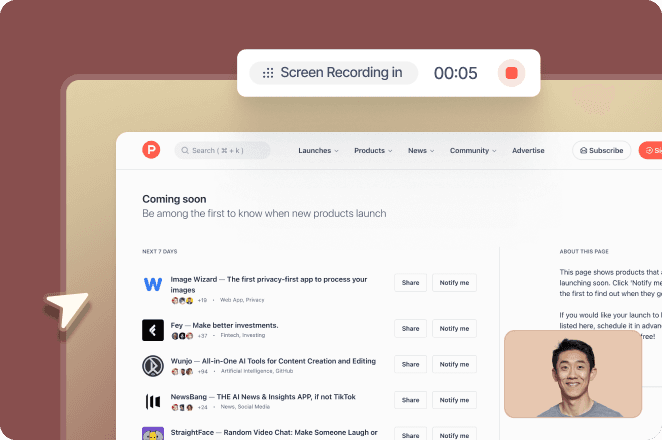
Begin by using Trupeer's AI screen recording feature. Open the browser-based recorder to capture your screen activities without installing any additional software. Ensure auto-zoom and click detection are enabled to highlight crucial actions. This setup not only captures high-quality video but also ensures that key interactions are emphasized, making it easier for the AI to generate accurate documentation later. A typical recording session might take 30-60 minutes, but the clarity it provides is invaluable for the next steps.
Step 2: Enable automatic filler-word removal
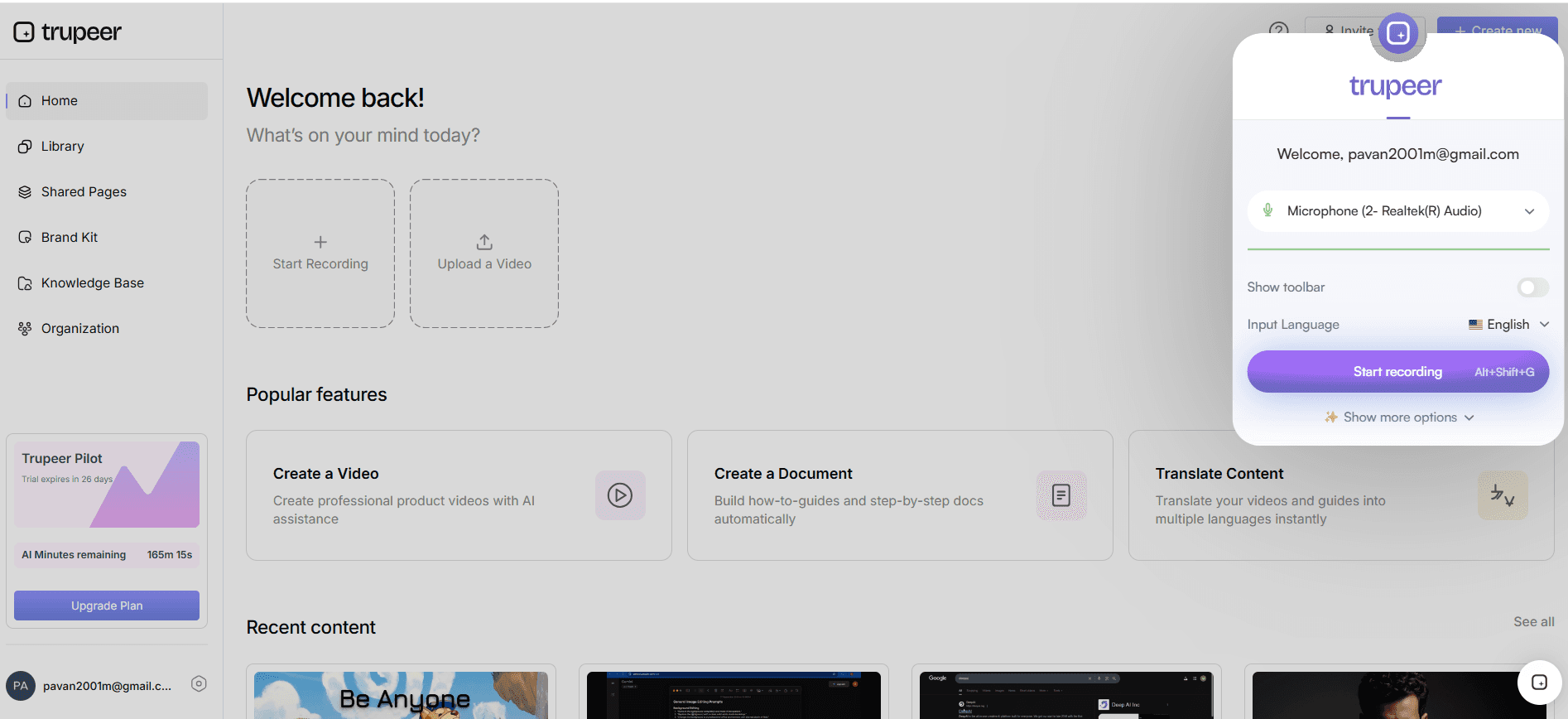
After capturing your recording, use Trupeer's automatic filler-word removal capability. This feature eliminates unnecessary "ums," "ahs," and long pauses, resulting in a cleaner audio track. Access this by selecting your recorded video in the Trupeer dashboard and enabling the feature in the editing menu. This process is typically quick, taking only a few minutes, and it significantly enhances the overall quality of your documentation by focusing on the essential content.
Step 3: Generate AI voiceover for clarity
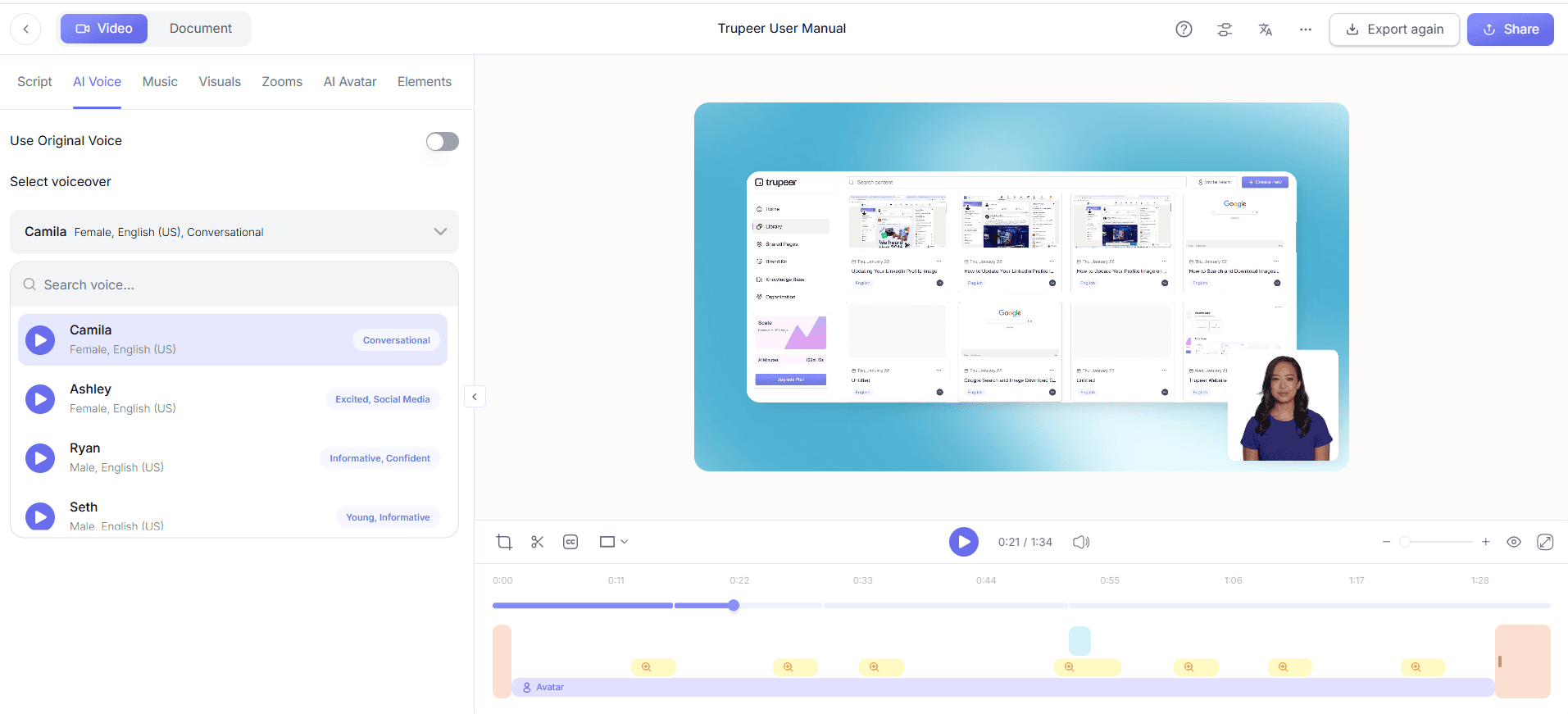
Next, add an AI-generated voiceover to your recording. Choose from over 65+ natural voices available in Trupeer's library, adjusting the pace and tone to suit your audience. In the video editing section, select "Add Voiceover" and pick your preferred settings. This step enriches your documentation by providing clear audio guidance, making it more engaging and easier to understand. The entire process from selection to implementation usually takes around 10 minutes.
Step 4: Create chapters and segments
Use Trupeer's auto chapters and segment detection feature to break down your recording into manageable sections. This is done automatically once you enable the feature in the dashboard. These chapters make it easier for readers to navigate the documentation, particularly in lengthy or complex recordings. The segmentation is typically completed in a matter of seconds, providing a structured outline that enhances readability and accessibility.
Step 5: Export documentation in multiple formats
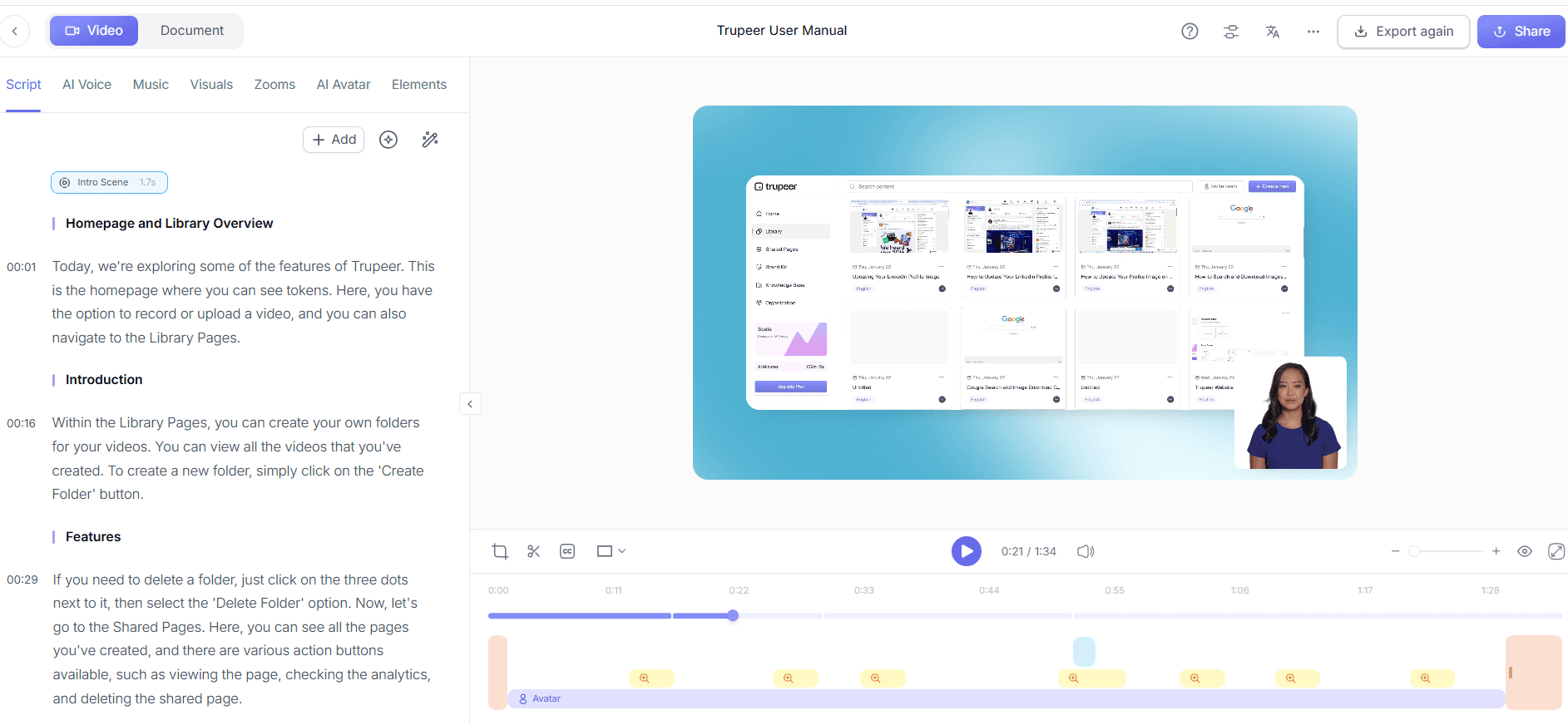
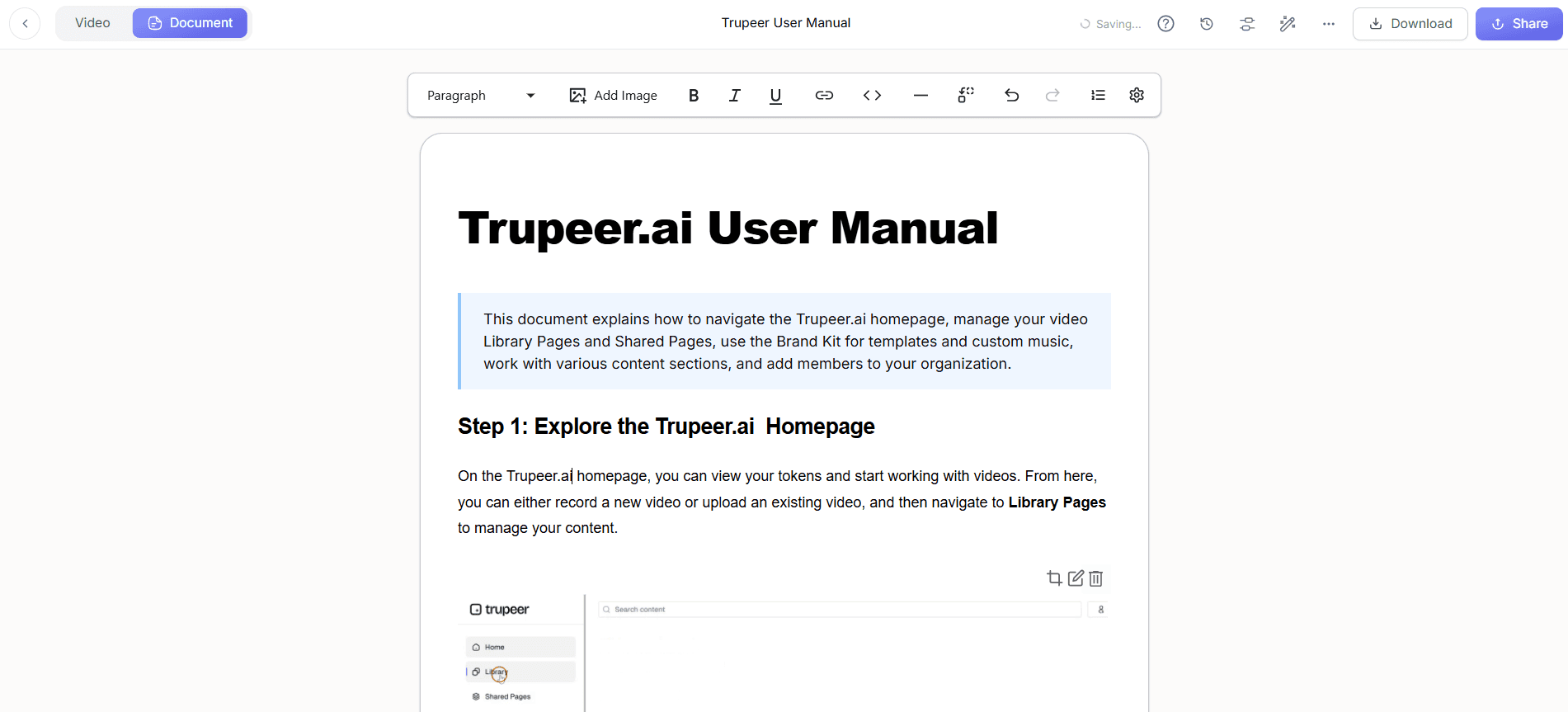
With your recording refined, it's time to export your documentation. Trupeer supports various formats including MP4, HTML, PDF, and SCORM. Navigate to the export section and select the desired formats. This flexibility allows you to distribute the documentation across different platforms, catering to various audience preferences. The export process is swift, usually taking only a few minutes per format. For a deeper comparison of features, consider a Loom alternative comparison.
Step 6: Integrate into knowledge base
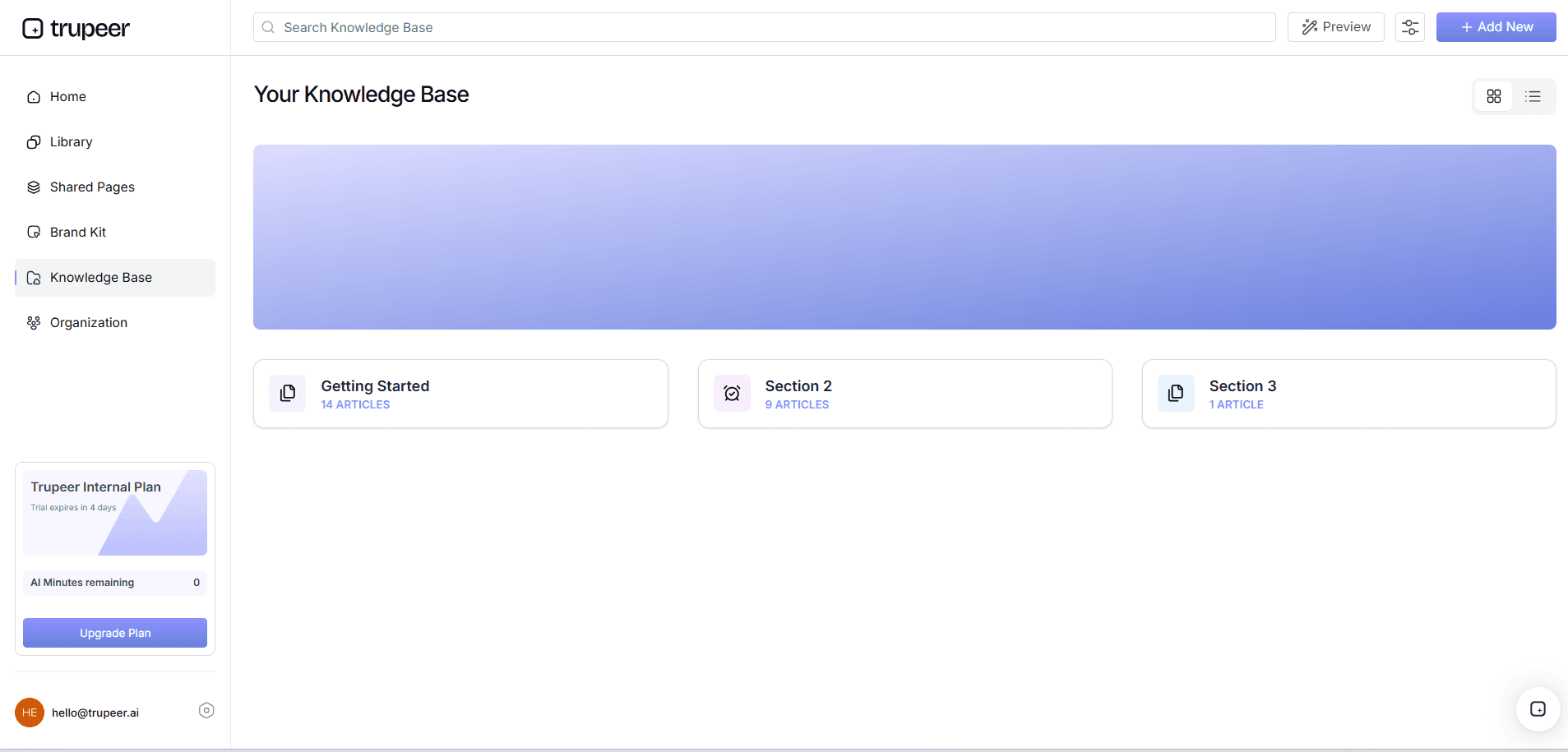
Finally, integrate your refined documentation into Trupeer's AI-searchable knowledge base. This ensures that all your team members can easily access and use the documentation. Go to the knowledge base section in the dashboard and upload your documentation. This feature supports timestamp-level deep links, making it exceptionally easy to find specific information. Integration is smooth and usually completed in about five minutes. This step is crucial for maintaining an organized repository of knowledge, especially for teams with extensive documentation needs.
What tips help you prompt AI to generate better documentation from recordings?
Effective AI prompting requires strategy and know-how. Here are some actionable tips to enhance your documentation process:
Define your audience. Tailor your prompts to match the knowledge level and needs of your audience. This ensures the AI-generated content is relevant and engaging.
Be specific with prompts. Clearly outline the context and objectives for each section of your documentation to guide the AI effectively.
Use consistent terminology. Standardize the language in your prompts to maintain consistency across all documentation outputs, which is crucial for clarity.
use AI features strategically. use features like auto-zoom and filler-word removal to enhance the quality of your recordings before generating documentation.
Review and refine outputs. Always review the AI-generated documentation and make necessary adjustments to ensure accuracy and completeness.
Standardize capture style. Use a documentation app with auto-zoom for consistent visuals.
Regularly update your prompts. As your documentation needs evolve, revise your prompts to ensure they remain effective and aligned with your objectives.
When SOPs come into the same conversation, a Scribe alternatives comparison helps clarify the scope.
Frequently asked questions
How does AI improve documentation efficiency?
AI enhances documentation efficiency by automating the transcription and formatting processes. It analyzes recordings to generate organized, accurate documents quickly. With features like auto-zoom and filler-word removal, AI minimizes manual editing time, allowing teams to focus on strategic tasks. This accelerated workflow not only saves time but also improves the overall quality and consistency of documentation outputs.
What are the best practices for prompting AI effectively?
The key to effective AI prompting lies in clarity and specificity. Begin by clearly defining the document's purpose and audience. Use precise language and consistent terminology. Break down complex content into manageable sections with clear headings. Regularly update your prompts to align with evolving documentation goals. By following these practices, you ensure that the AI produces content that meets your expectations and serves your audience effectively.
Why is Trupeer suitable for AI-generated documentation?
Trupeer is ideal for AI-generated documentation due to its comprehensive suite of features designed for precision and efficiency. Its capabilities, such as automatic SOP generation and multi-format export, simplify the documentation process. The platform's ability to create an AI video translation ensures that documentation is accessible to a global audience, enhancing its usability and reach.
Can AI-generated documentation replace human editors?
While AI significantly enhances the documentation process, human editors remain crucial for ensuring accuracy and context. AI excels at drafting and organizing content, but human oversight ensures that nuances and specific business requirements are met. By combining AI's efficiency with human expertise, organizations can achieve high-quality documentation that is both precise and contextually aligned with their needs.
Does Trupeer support multilingual documentation?
Yes, Trupeer supports multilingual documentation, offering AI translation into over 40 languages with lip-sync capabilities. This feature is particularly beneficial for organizations with a diverse workforce or customer base. By providing documentation in multiple languages, Trupeer ensures accessibility and comprehension across different geographical regions, enhancing communication and reducing the risk of misunderstandings in global operations.
Related Blogs